

I honestly feel a little guilty writing this post.
A few weeks ago, at the end of my trip to Nauka Golf Club in Mexico, I was chatting with one of the members — a name you’d definitely recognize if I told you, which I won’t. He pulled me aside and said something I haven’t been able to shake: “Please don’t spoil this place. I’m hoping to get at least a couple more years of it like this.”
I get it. I really do.
But here’s the thing about running a golf blog for over a decade: occasionally, it takes you somewhere you have absolutely no business being.
I’ve had a handful of those moments.
Playing Kohanaiki on the Big Island, one of the most exclusive private clubs in America.
Spending time at Sensei Porcupine Creek, a place so over-the-top it made every other “luxury” experience feel like a Hampton Inn.
Getting an invite to Gozzer Ranch on the shores of Lake Coeur d’Alene, which sits among the very top destination clubs.
And dozens more.
Each of those trips had a moment where I looked around and thought: how did I get here?
Nauka had about fifteen of those moments. Per day.
And the thing that really gets me, the part that I’m still processing, is that I didn’t do this one alone. I did this with my wife and daughter. Three days, fully immersed, in what I can now confidently say is among the most ambitious private golf club communities I’ve ever encountered.
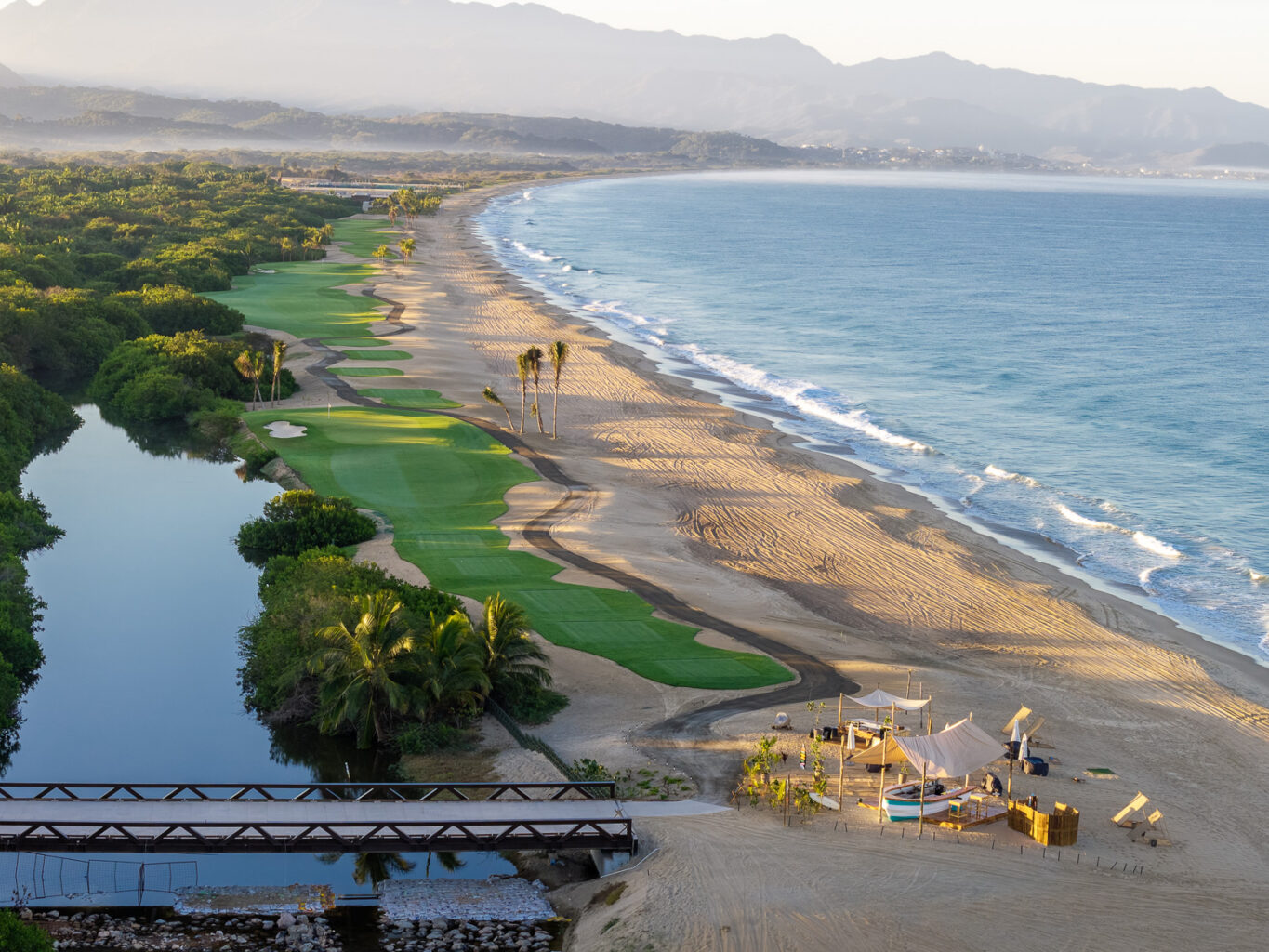
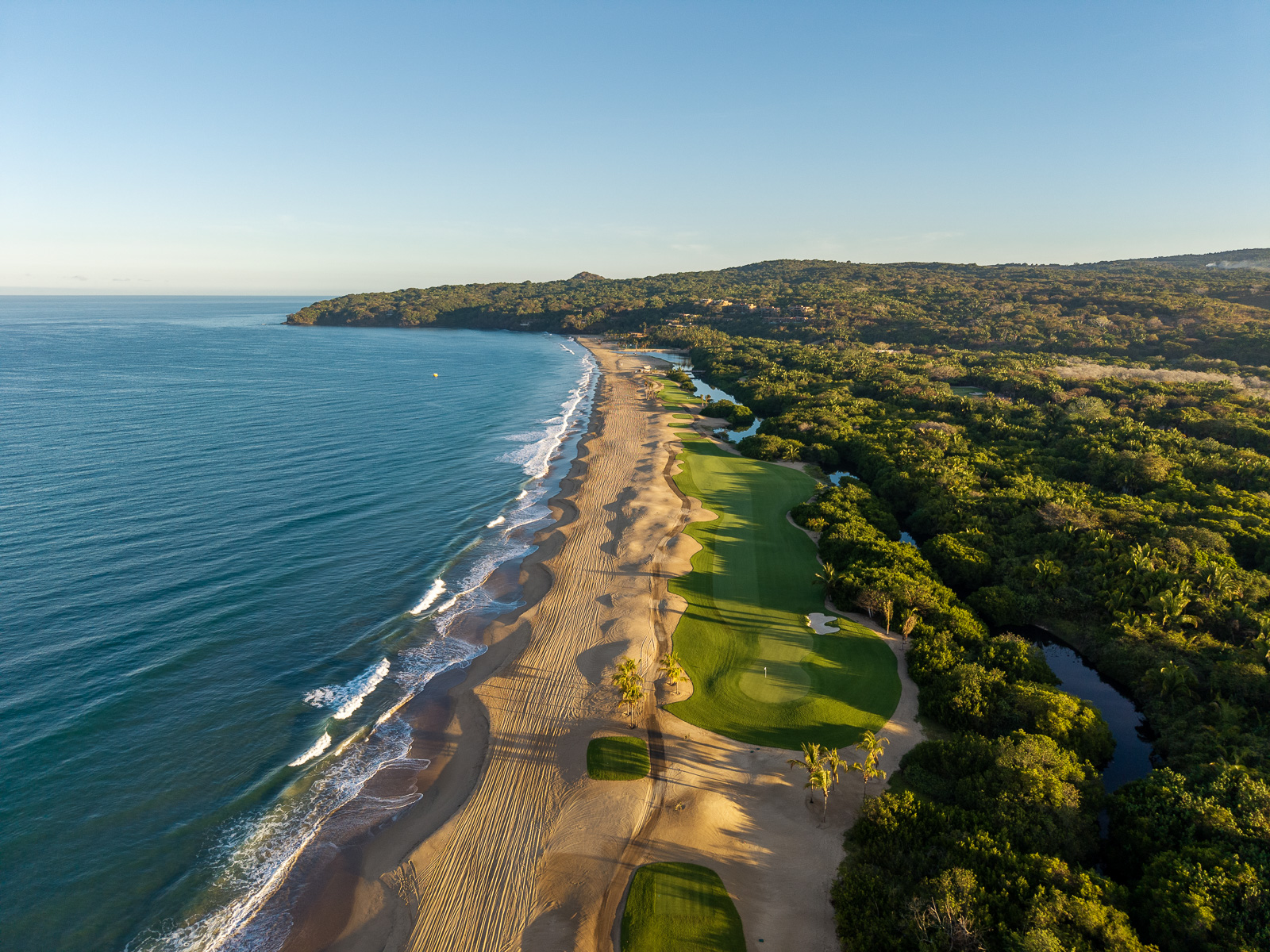
920 acres. Four distinct ecosystems. Over four miles of pristine Pacific coastline. A Tom Fazio golf course that the man himself may have called one of the three best he’s ever built.
And amenities, little touches, and experiences that truly set Nauka apart from other club experiences.
This is unlike any golf club you’ve ever seen. Let me show you around.
What is Nauka Golf Club?
Nauka is a private club community set on 920 untouched acres along Mexico’s Riviera Nayarit coast, less than an hour from the Puerto Vallarta airport thanks to the new toll road and enhanced infrastructure.
If you’ve never heard of Riviera Nayarit, think of it as the quieter, more unspoiled stretch of Pacific coastline just north of Puerto Vallarta — a region that has largely avoided the over-development that’s crept into other parts of Mexico’s resort corridors.
The property takes its name from the Huichol word for “four,” a nod to the four distinct ecosystems that define the land: old-growth jungle, volcanic cliffs, mangrove estuary, and more than four miles of Pacific oceanfront, including over two miles of golden sand beach.
With just 395 lots planned across the entire property, Nauka is intentionally keeping things small and exclusive. Right now, the club is still in its early stages, and honestly, that’s part of what makes this moment special.
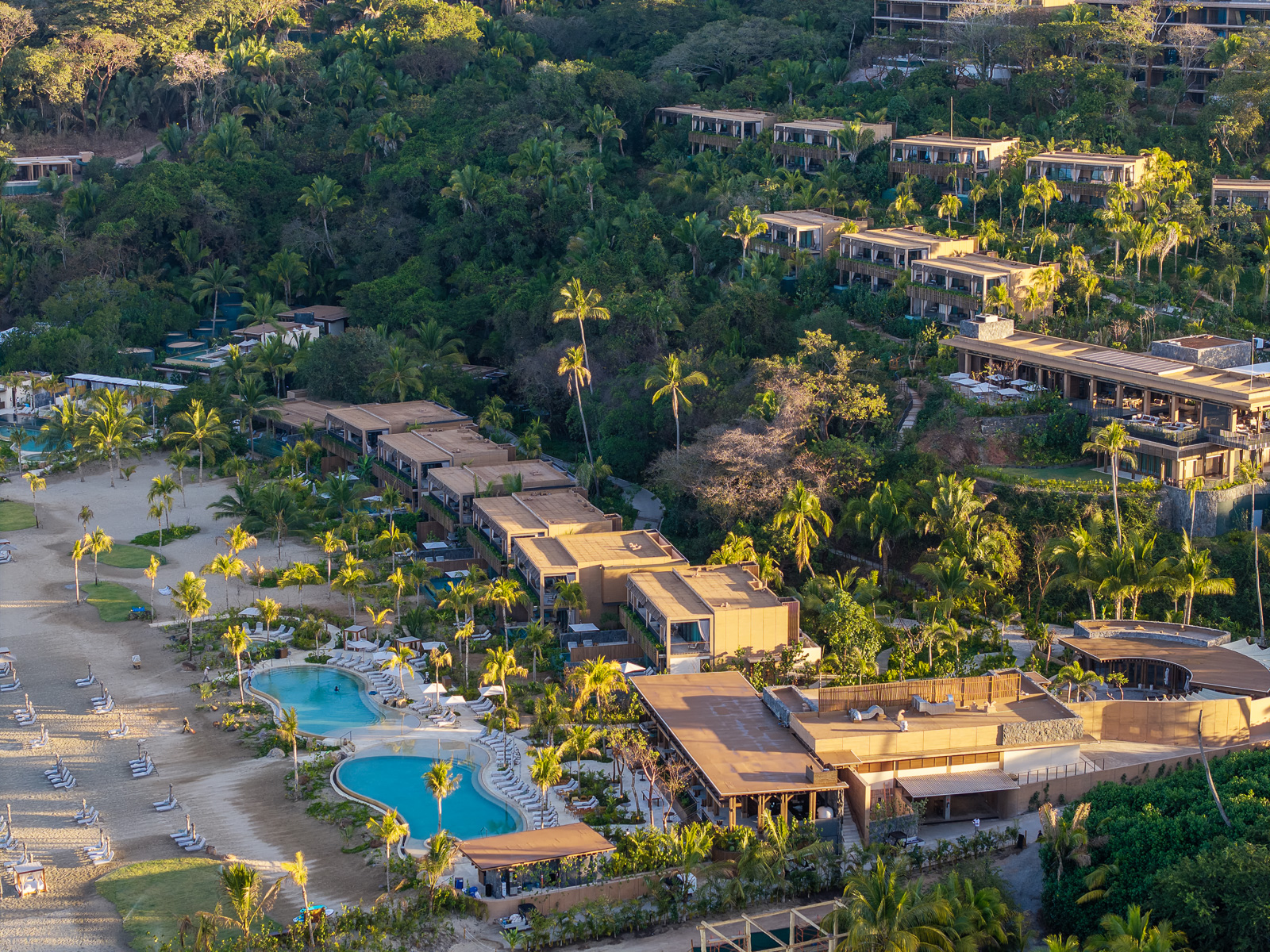
The championship Tom Fazio golf course has only been open for about a year. The Beach Club is running. The Village serves as the social hub of the property. But there’s significantly more to come: a full marina and yacht club, a sports complex, and amenities that will eventually make this one of the most complete private communities in the world.
Right next door sits Siari, one of only nine Ritz-Carlton Reserve properties on the planet, which shares ownership with Nauka. More on that later — because for a small number of people reading this, Siari is actually your way in.
But first, let’s jump into the Nauka experience.
Arriving at Nauka
One of the best things about Nauka is just how surprisingly convenient it is to get there.
In mid-February, my wife, daughter, and I hopped on an early morning direct flight to Puerto Vallarta from PDX. By early afternoon, 1pm Portland time, we were pulling up to the Village at Nauka. It’s hard to believe that in half a day we could be in a place that feels so exotic and removed from real life.
From the moment you step out of the car, it’s clear that service here operates on a different level. The communication between staff is seamless — everyone knows who you are, what you prefer, and it often feels like they know what you need before you do.
We were greeted at the Village and escorted to one of ten villas on the property, which serve as the primary guest accommodation while the broader community continues to develop.
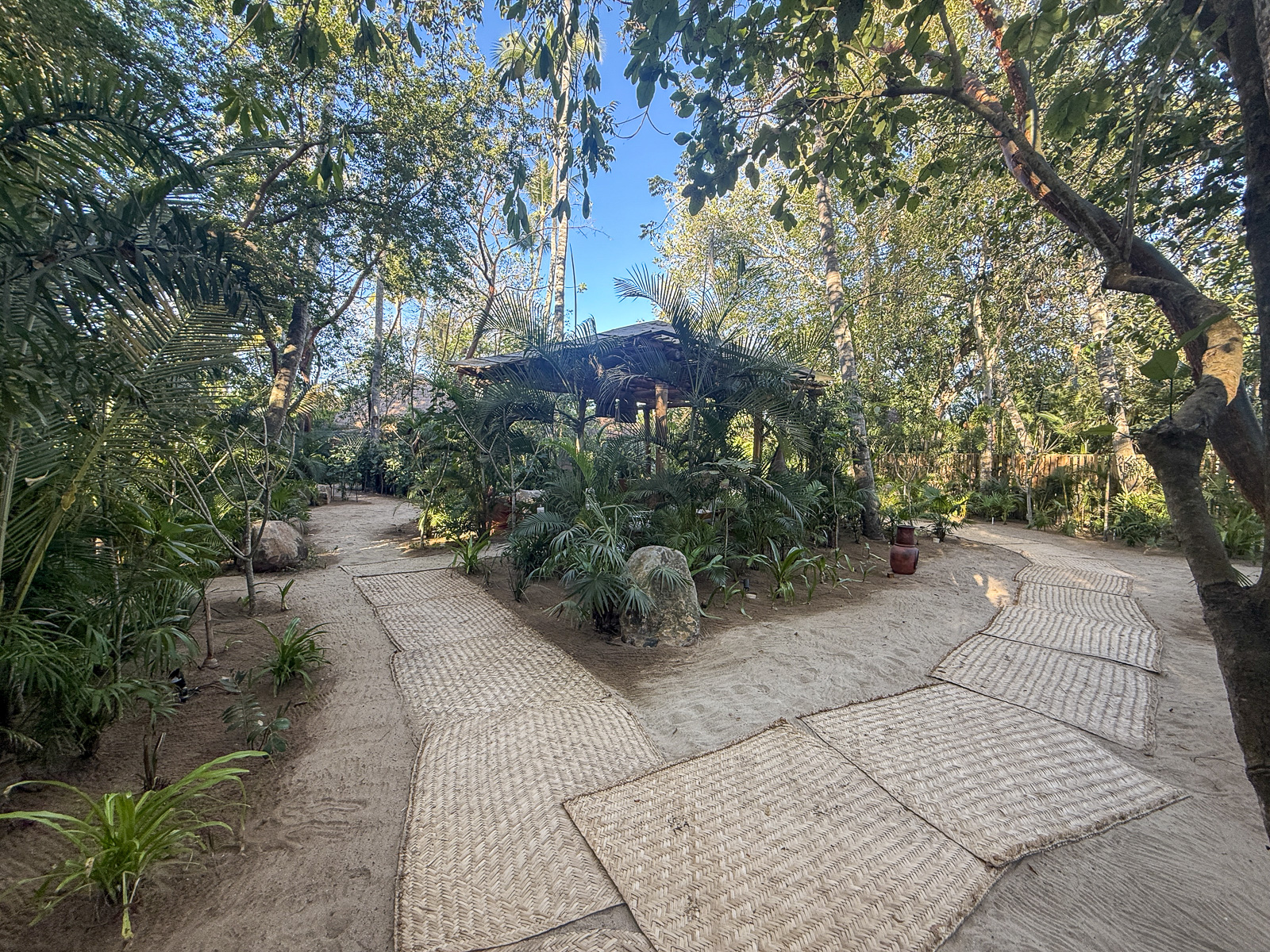
The walk to the villa set the tone immediately. A winding path through dense jungle, with little hidden discoveries along the way: a sauna tucked into the trees, a cold plunge, a quiet courtyard designed for massages, sound baths, or just sitting still for a moment. It reminded me, oddly, of my time living in Thailand. Specifically, of a small jungle village called Ton Sai outside Railay Beach.
Just, you know, with considerably more luxury and considerably fewer backpackers.
This part of the development is part of a planned 15-acre jungle wellness retreat, which will evolve as the club grows. But granted, it’s already a very cool experience.
Emerge from the jungle, and you’re treated to a full tropical playground.
We’ll come back to the Village and everything else Nauka has to offer beyond the ropes. But first, the reason most of you are here: Let’s talk about the golf course.
The Nauka Golf Course
The property at Nauka is close to 1,000 acres, and you feel every bit of it. Getting to the course from the village is a five-minute ride in a Can-Am or golf cart, and while members typically have their own carts, there was always staff ready to take us wherever we needed to go without a second’s wait.
Pulling up to the course, the first thing you see is a brand new pro shop. Fully stocked, beautifully done. But here’s the thing: the dress code conversation at Nauka isn’t the one you’d have at most private clubs. It’s not about whether you need proper golf shoes and a collared shirt. It’s more like: do you need a shirt and shoes at all?
Head Professional Kyle Leeper put it perfectly when we were out on the course together: “We definitely need more t-shirts in the pro shop.”
That tells you everything about the vibe. Everyone here is relaxed, everyone is happy to be here, and nobody is keeping score on anything other than their scorecard.
The Course Design
Tom Fazio had a deceptively difficult job in front of him when he set out to design Nauka.
On one hand, you’re working with one of the most spectacular and varied pieces of land a golf course architect has ever been handed: tropical jungle, a mangrove estuary, volcanic cliffs, and a stretch of Pacific beachfront that any course designer would lust over.
But the hard part? Building a course that works equally well for a PGA Tour pro and a ten-year-old on a family vacation.
Because Nauka is, above all else, a family place.
“You’re probably not joining here if you’re 42 and single,” Kyle told me during our round.
This is a legacy community in the truest sense. The membership is vertical; your parents and your kids are just as welcome here as you are. Everything being built, every decision being made, is filtered through that multigenerational lens. And that means the golf experience has to be genuinely approachable for a complete beginner.
At the same time, Nauka is very clearly on the radar of the best golfers in the world. There are at least a half dozen PGA Tour and LIV players who are members here.
One of them walked straight up to our table at dinner at the Beach Club to introduce himself. I was genuinely caught off guard by how warm and down-to-earth he was. But that’s also the nature of a place like this. If you’re here, everyone else here understands why, and there’s a quiet mutual respect that comes with that.
The result is a course that can play wildly differently depending on what you’re looking for.
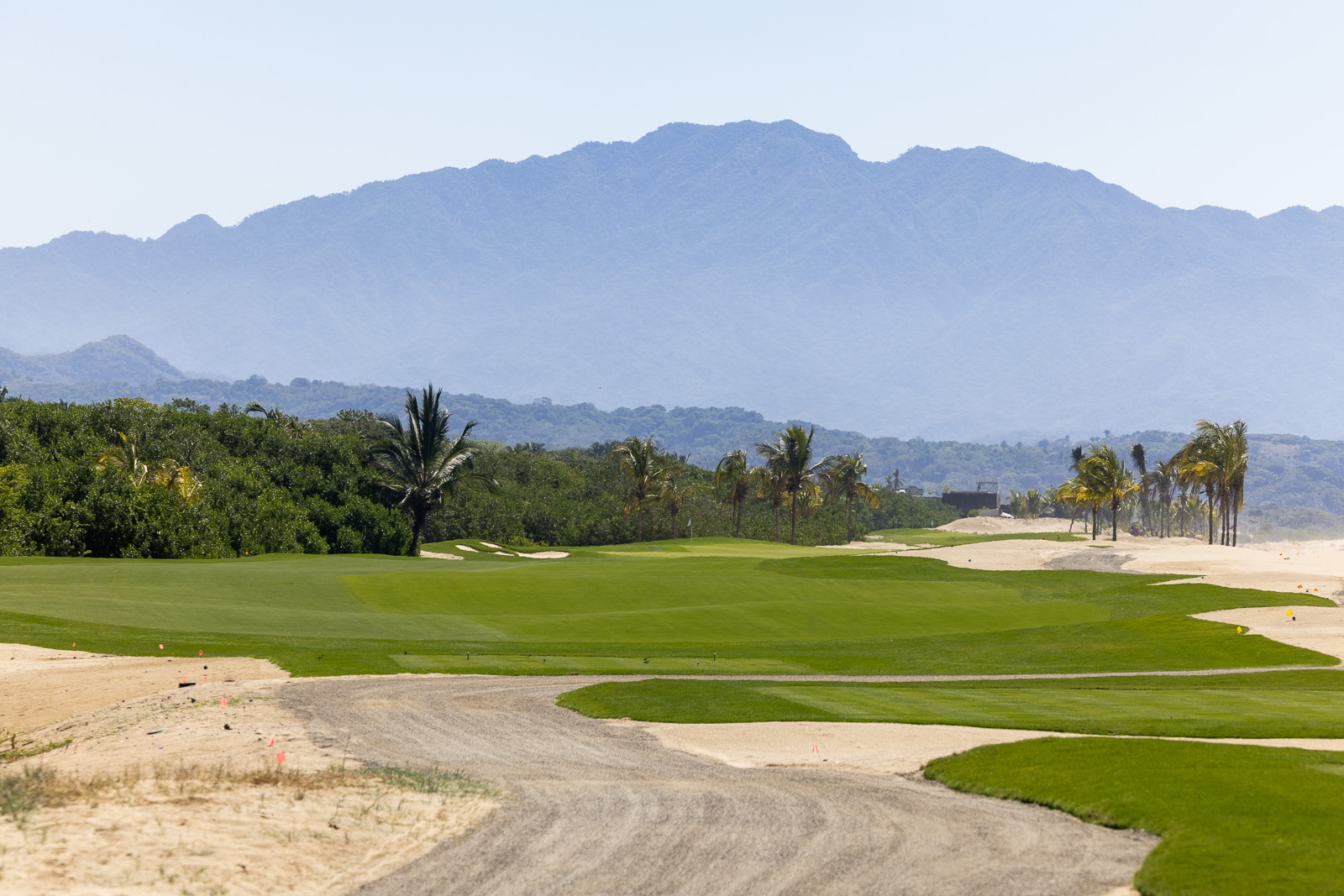
Stretched to 7,600 yards from the tips, it offers all the challenge the best players in the world could want. But for the newer golfer, the design is quietly accommodating. Most greens are open in front, allowing you to run the ball up rather than fly it, and five tee box options give every player a legitimate starting point.
When I played with my wife and daughter, we simply picked holes and dropped a tee anywhere from 75 to 175 yards out in the middle of the fairway. It was perfect.

The entire course is planted in paspalum grass, which is the turf of choice for tropical coastal environments like this. It handles the heat, tolerates the salt air, and can even be watered with brackish water if necessary. Despite the course being less than a year old, it was easily one of the most immaculate surfaces I’ve ever played. It felt dialed in. Perfect, even.
Kyle did mention that the one area still coming along is green speed. They’re working their way up to full tournament pace, as you’d expect from such a young course. But honestly? They were rolling at least a 10 during my rounds, and the surfaces were so flawless that if you missed a putt out there, you had nobody to blame but yourself.
The Range is Among the Best in the World
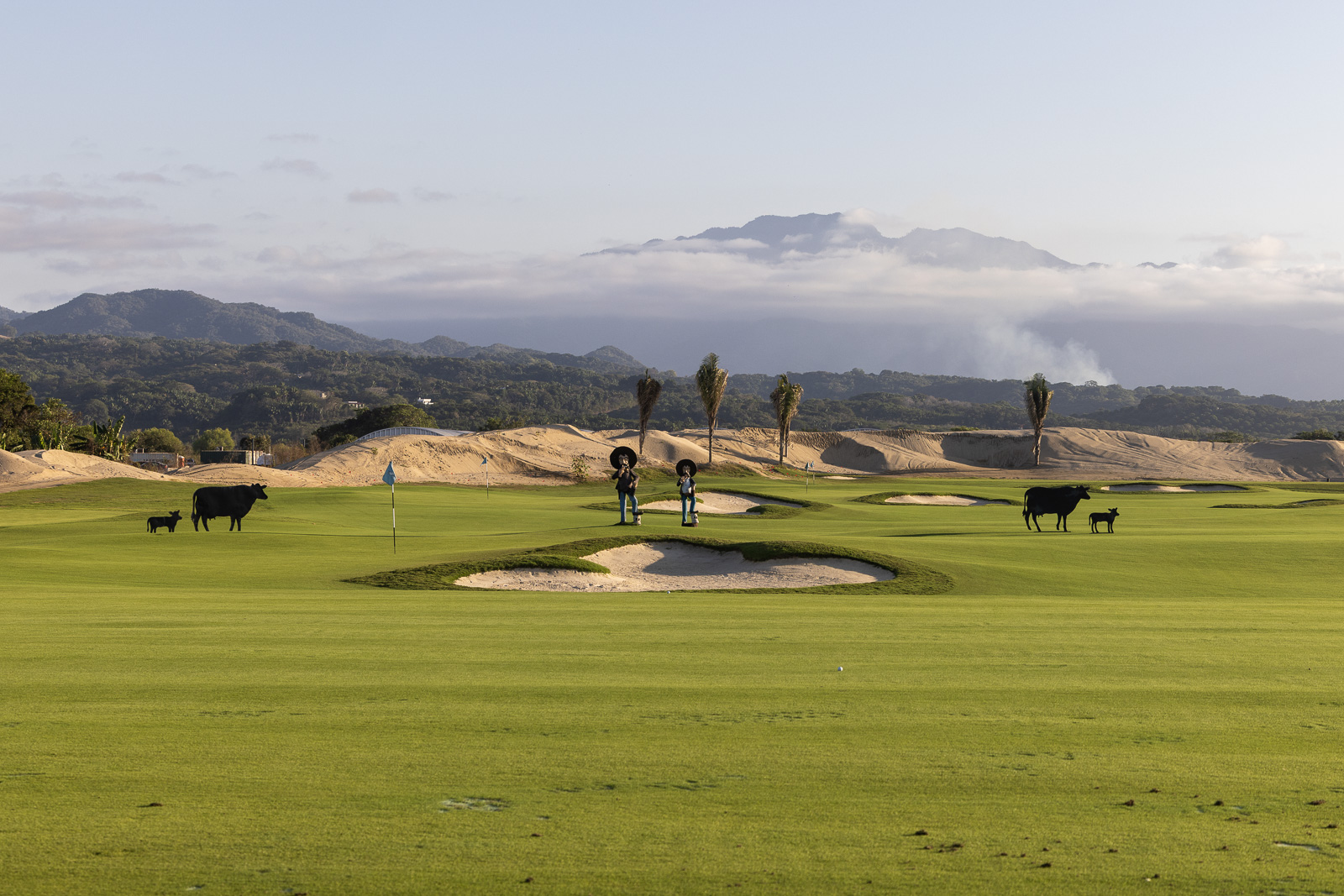
The range at Nauka is among the best I’ve ever experienced, and I’ve experienced a few.
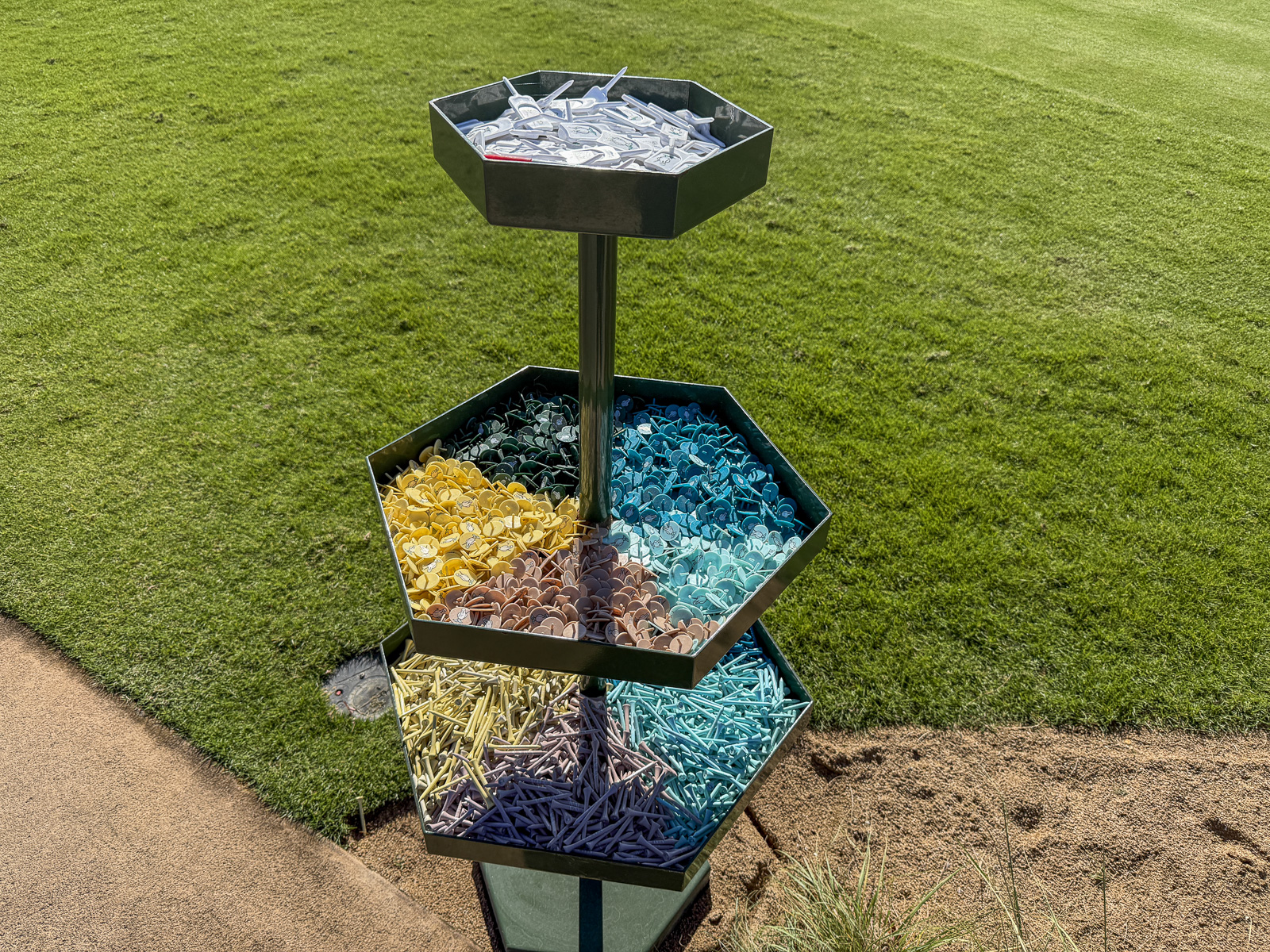
Every color tee and ball marker you could want is laid out on a cart waiting for you. A half dozen Full Swing Kit launch monitors are available for anyone to use at any time. And Pro V1s? Those come standard.
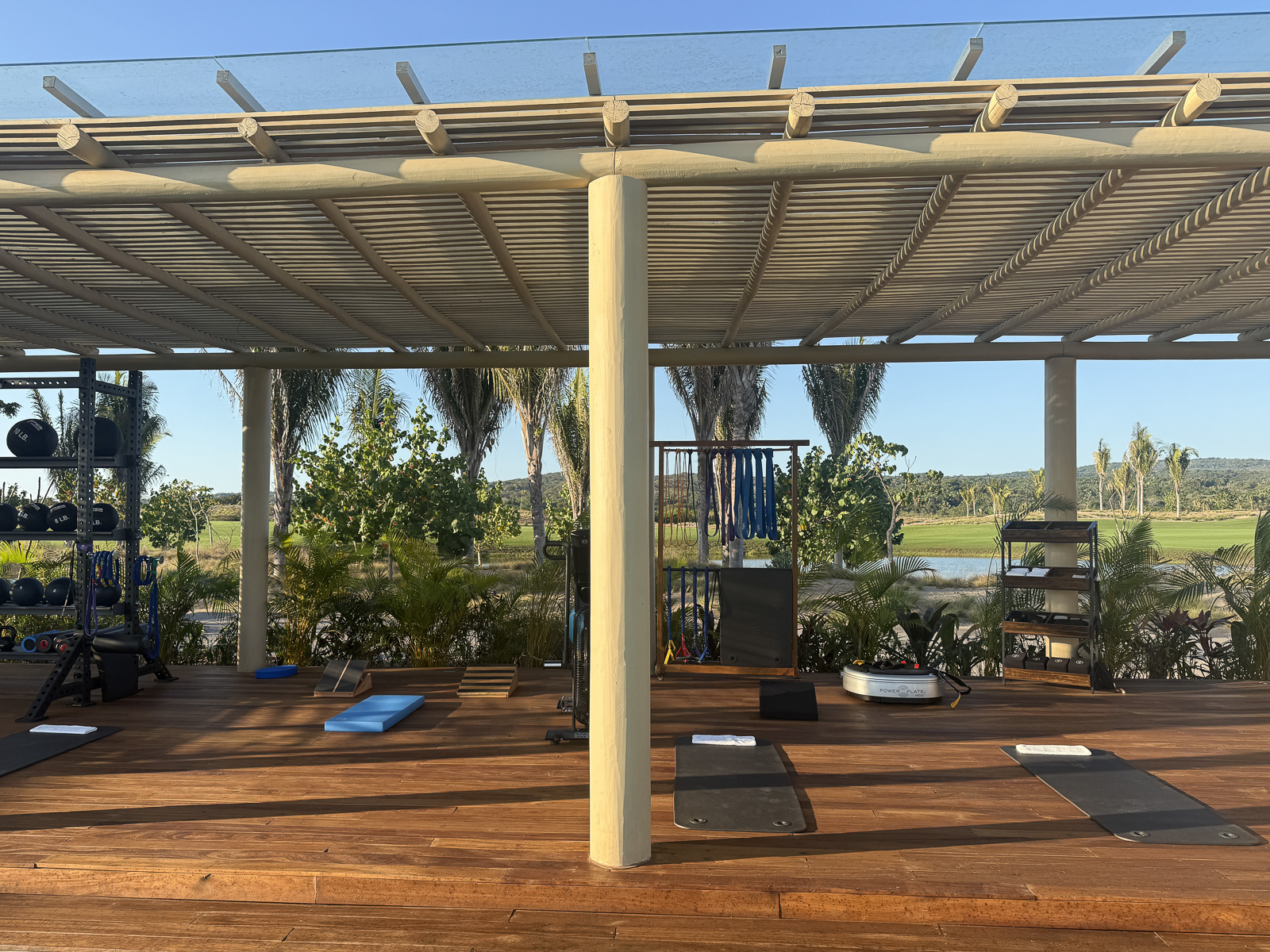
There’s music playing. The club recently finished a spectacular stretching and warm-up area right alongside the range, with enough equipment to get genuinely loose before a round, or to get a full workout in if you were so inclined. It’s the kind of setup that tour-level facilities charge a premium for, and here it’s just part of the morning.
At the range, you’ll also find the first of three comfort stations on the property. Fresh juices, breakfast options, coffee, all of it beautifully presented. It’s the kind of spot where you could easily lose track of time just chatting with members as they filter through.
Although fair warning: given how little traffic the course sees on any given day, you may be waiting a while for company.
The First Seven Holes at Nauka
The course wastes no time making an impression.
The opening hole is a brawny par 5, dogleg right with water lurking on the right and two bunkers that creep in from either side as you approach the green. From the very first shot, Nauka is asking you to have a plan. There’s no easing in here.
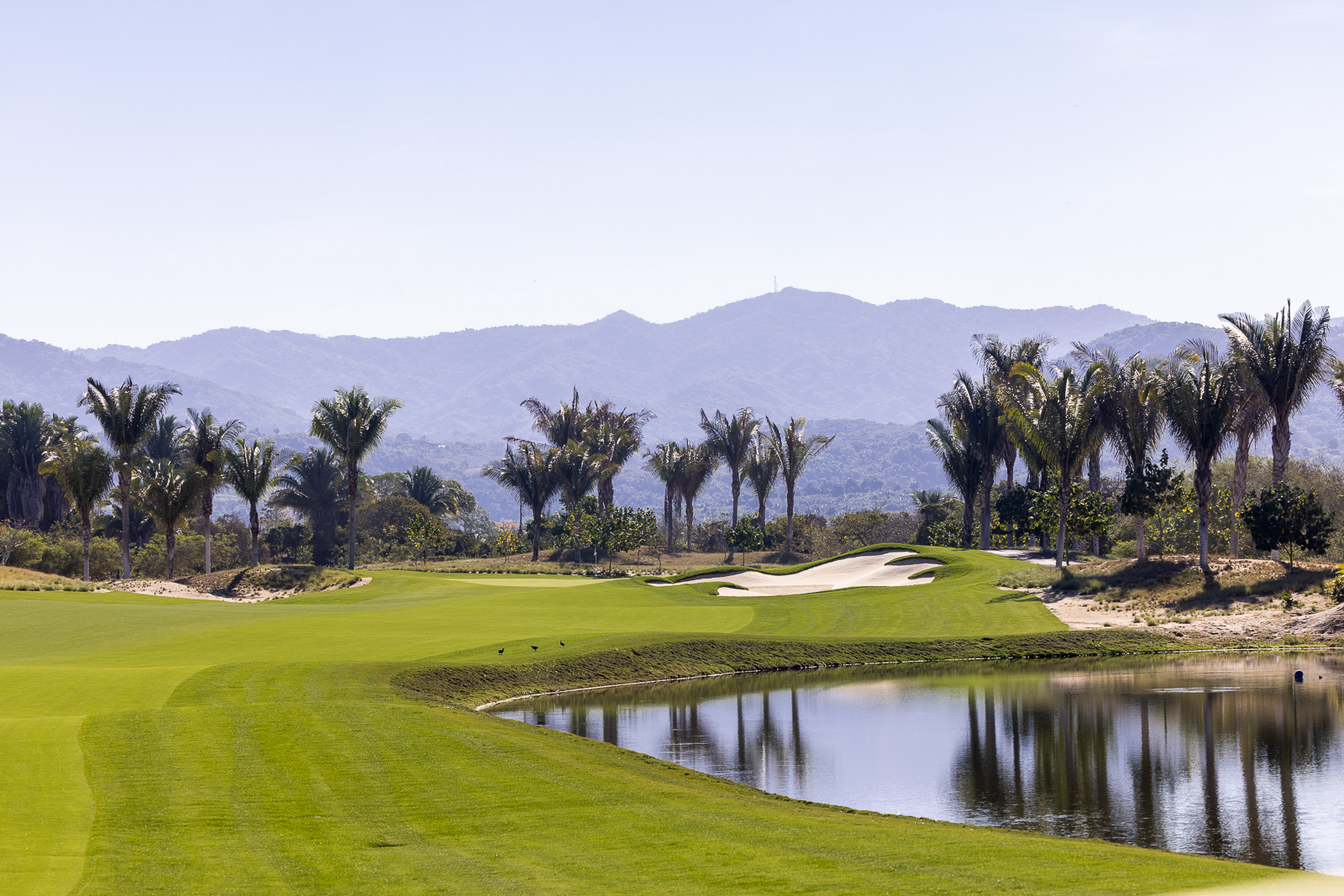
Hole 2 brings variety immediately, shifting to a longer par 4 dogleg left that keeps you honest before the course really starts to show its personality.
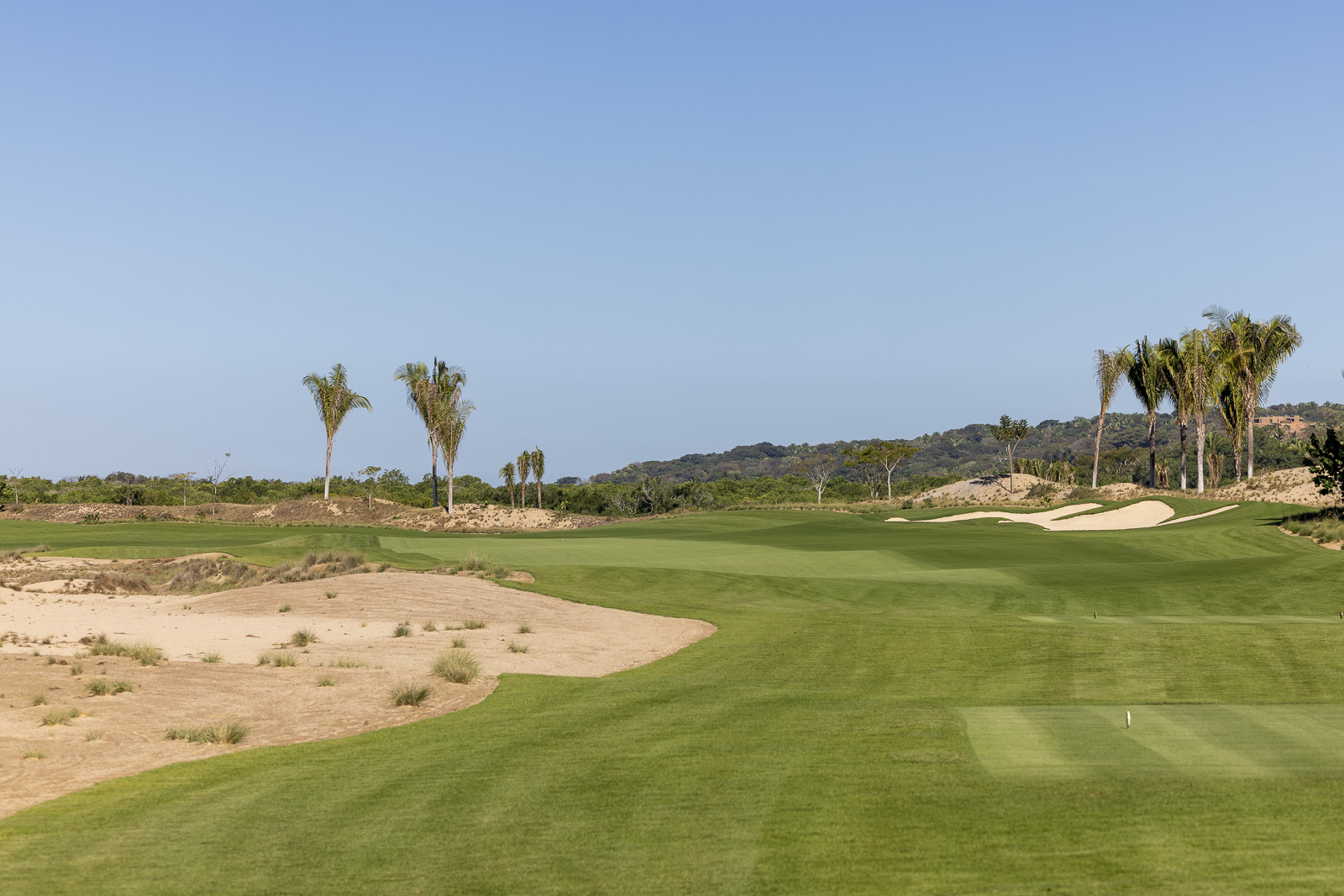
That personality comes into focus on the 3rd, which is one of my favorite holes on the entire course.
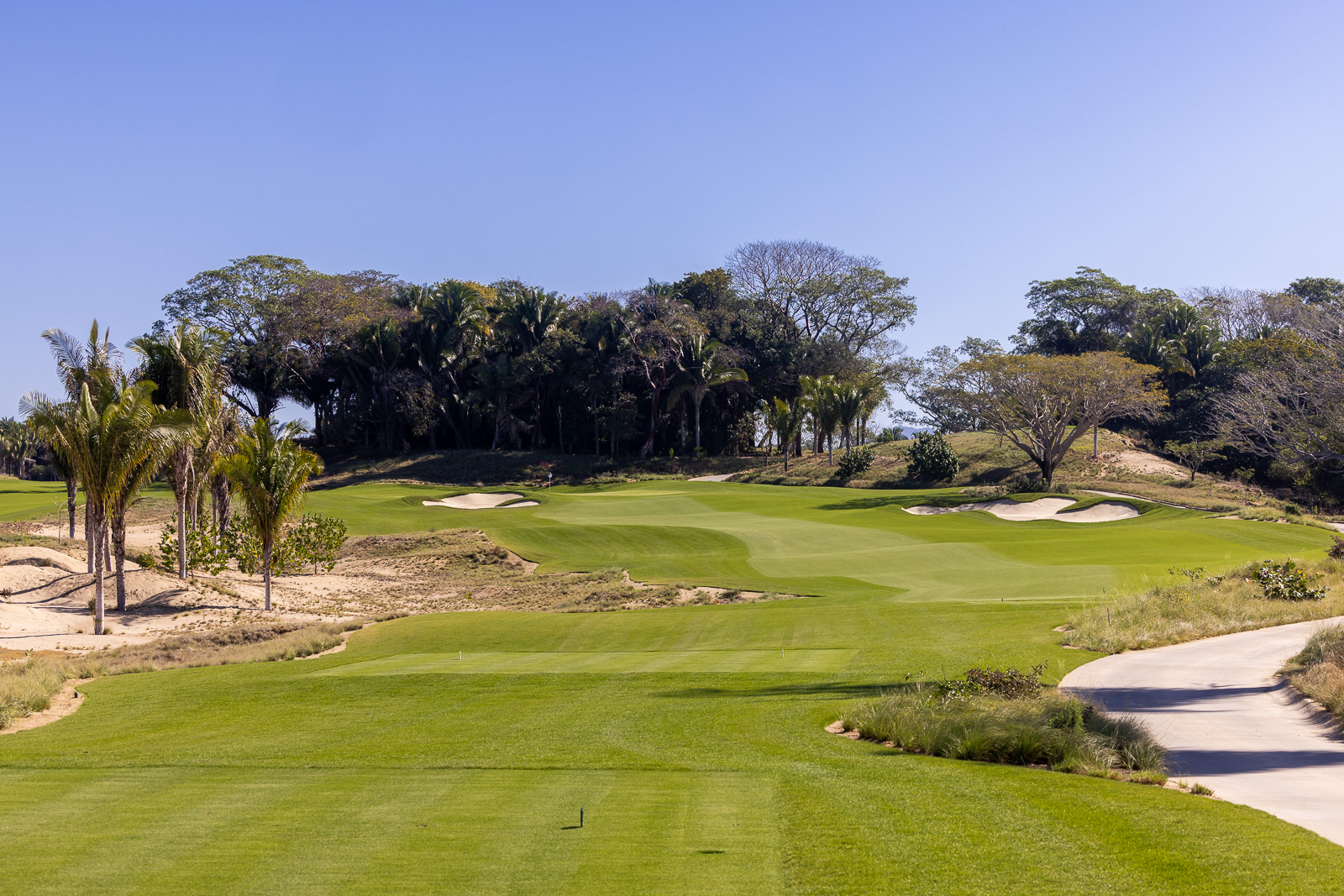
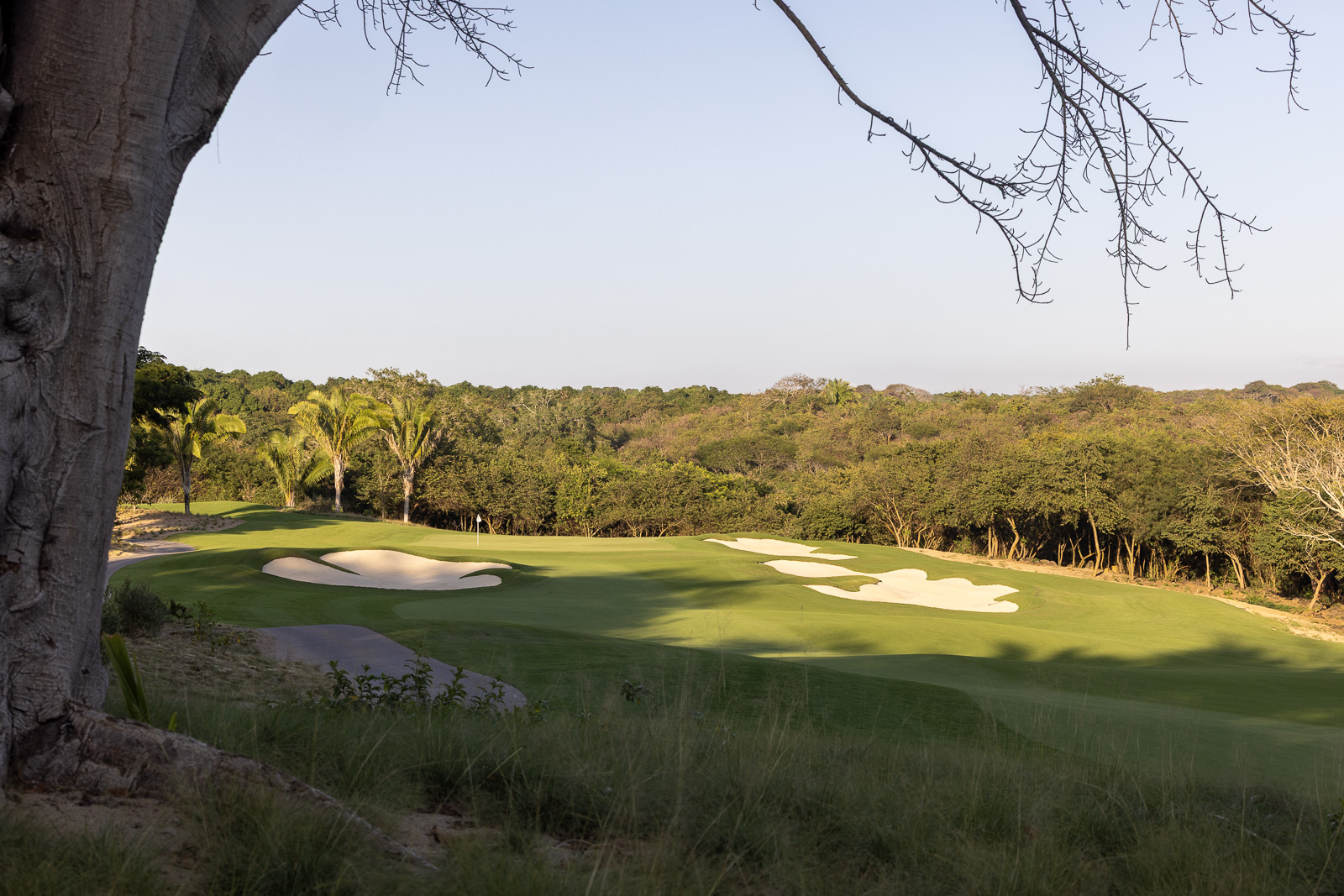
It’s a short par 4 that plays uphill toward a green tucked against a forest of palm trees. The fairway is wide and inviting, but that openness is a little deceptive. The best line is aiming at the right edge of the green; miss it, and you’re either in the right bunker or through the back. What I love about this hole is what it signals. You can feel the landscape shifting around you, the elevation starting to climb, the jungle closing in at the edges. It’s a transition hole in the best sense, a bridge between the opening stretch and what’s about to come.
The land that makes up holes 4, 5, and 6 wasn’t originally part of the Nauka property. But when Fazio told the developers that acquiring it would meaningfully elevate the golf course, it was a matter of weeks before the deal was done. Standing on these holes, you understand immediately why he pushed for it.
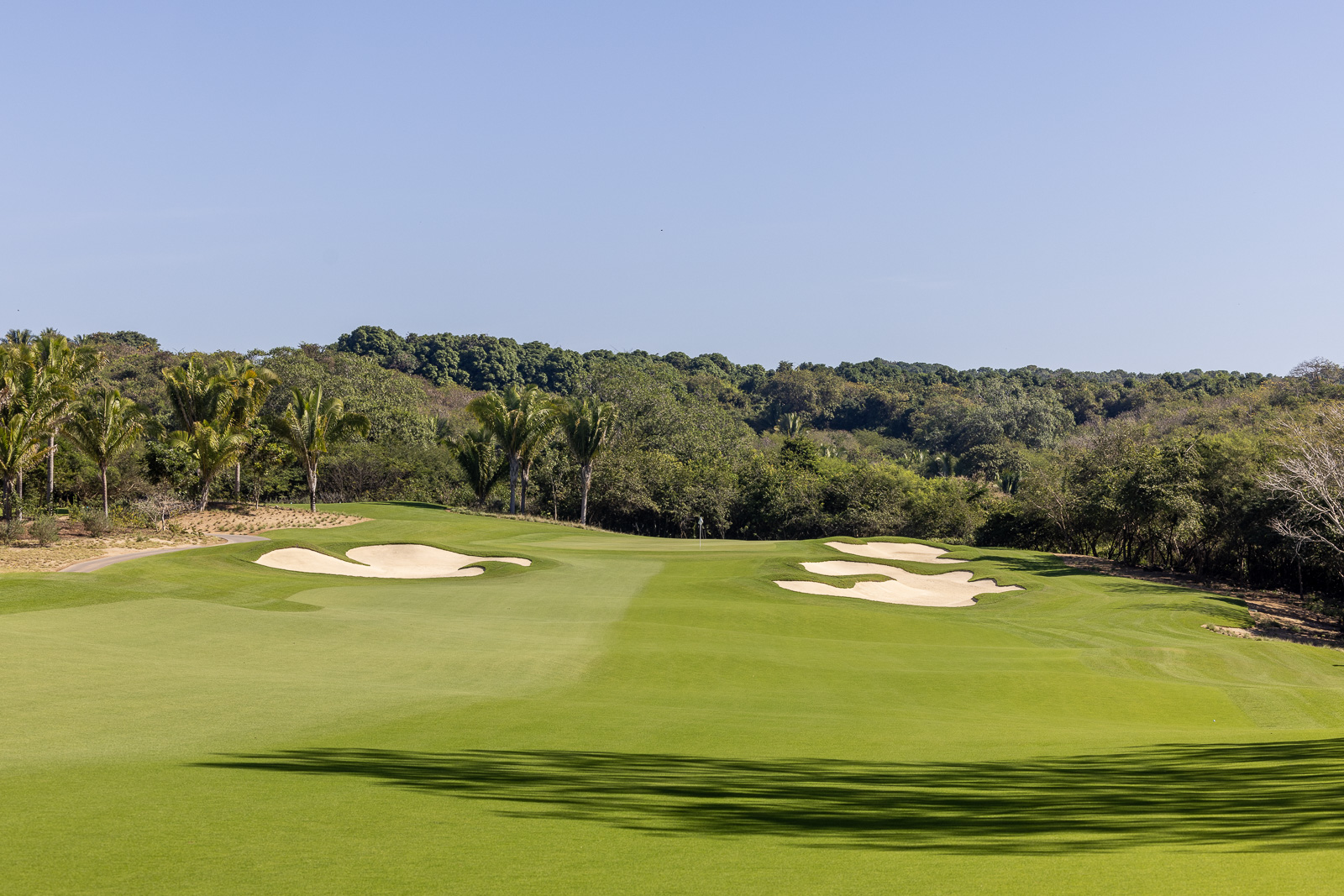
The 4th is a reachable par 5, and a genuine birdie and eagle opportunity that gives the average golfer a chance to put up a number. I found myself under a tree off the right side of the fairway and had to punch out, but still settled for a comfortable par. Kyle, meanwhile, had a tap-in eagle. Just a normal Tuesday at Nauka.
The 5th is a well-crafted par 3 tucked into the hillside, before the 6th delivers the first real tease of what’s coming: a glimpse of the ocean opening up in the distance. It’s just a glimpse, though. Don’t let it distract you, because the 6th is a beast of a par 4 that stretches beyond 500 yards from the tips.
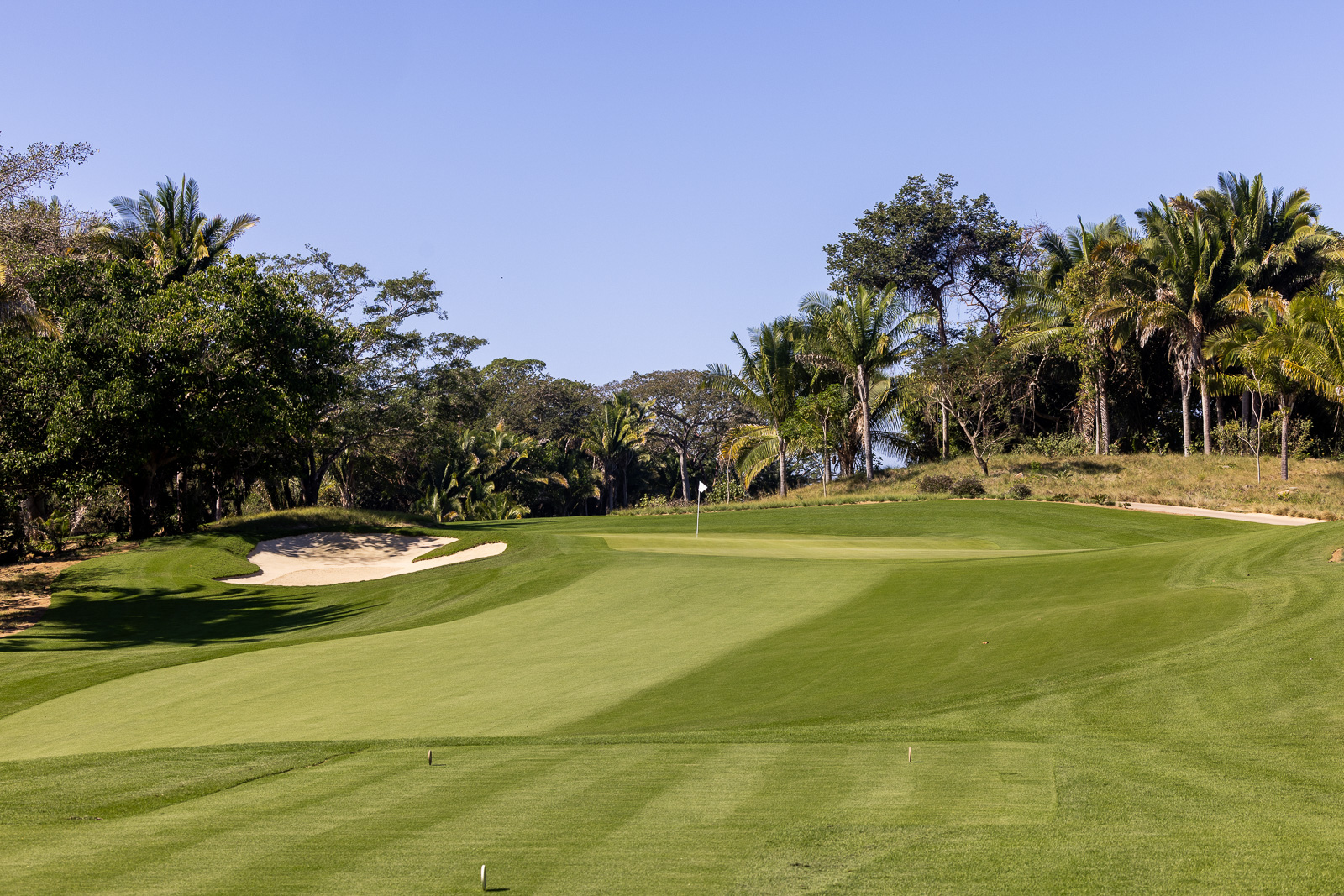
Then comes the 7th, which takes you back up the hill to the highest point on the entire property. And it’s up here, above the 7th green, that everything snaps into focus, not just the hole itself, but why Fazio fought so hard for that extra piece of land.
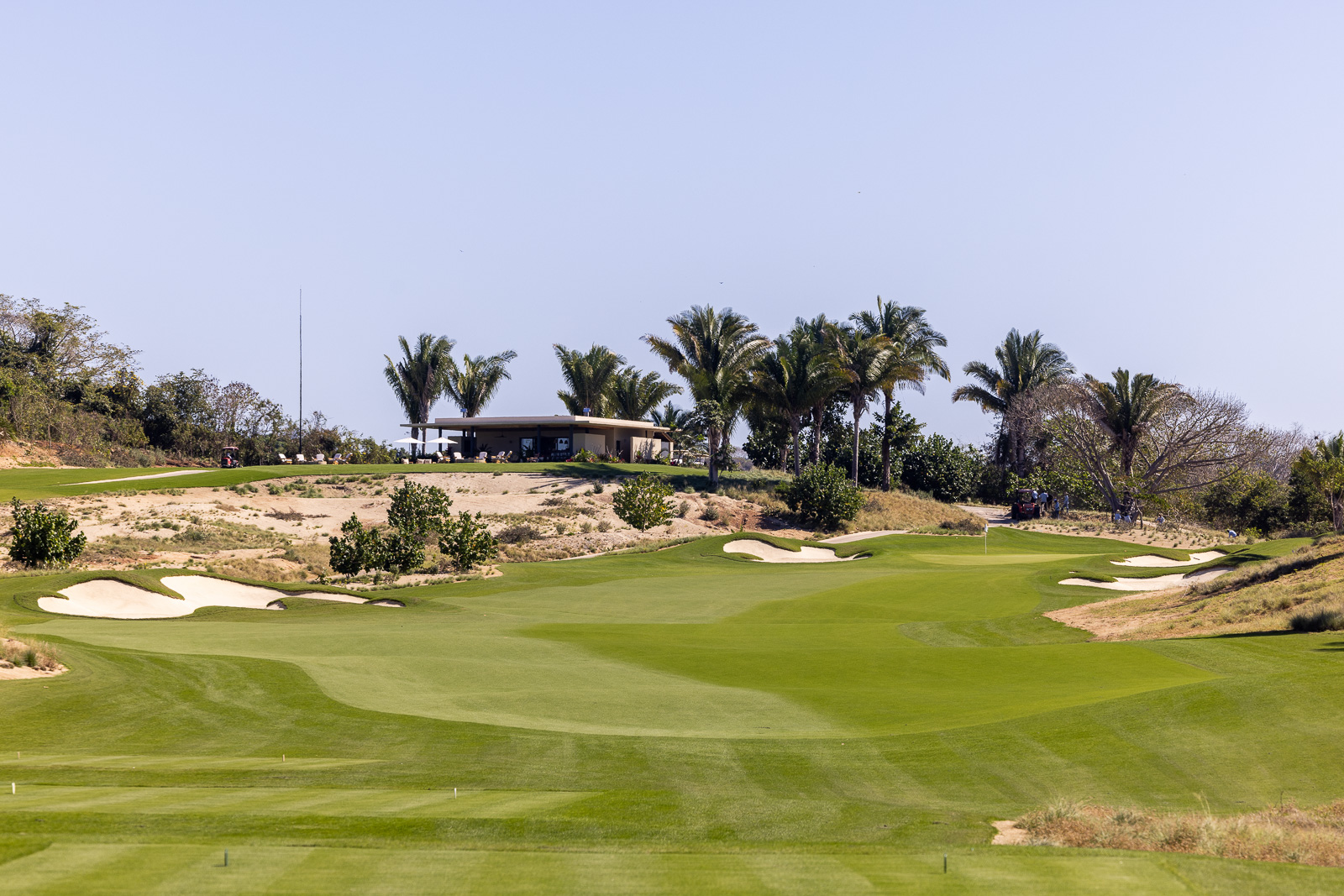
Directly above the 7th green sits the Nest. And that deserves a section all of its own.
The Nest: One of the World’s Great Halfway Houses
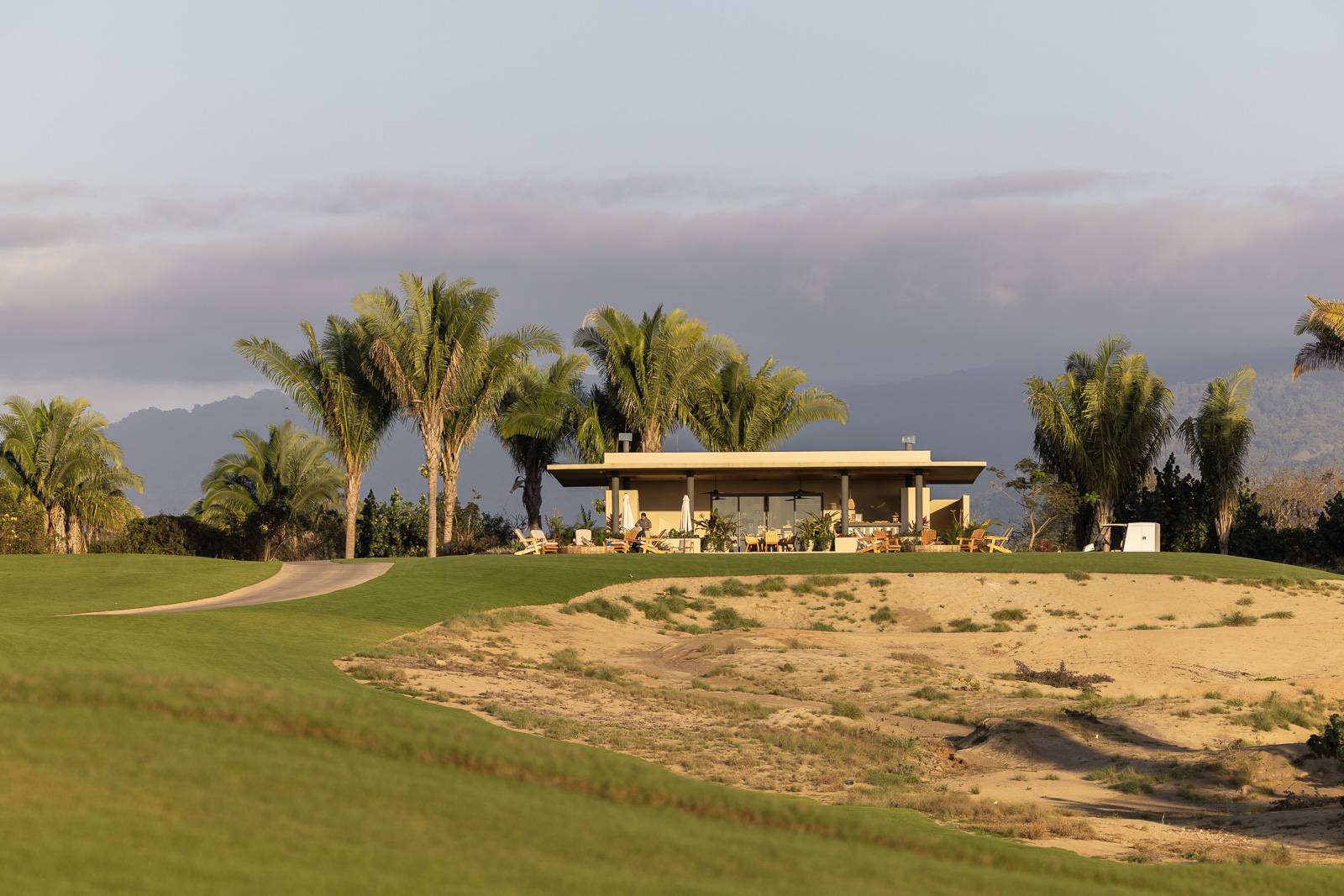
Perched at the highest point on the property, directly above the 7th green, sits the Nest, and calling it a halfway house feels like a disservice.
This is a destination.
From up here, you get sweeping views of the course below and the Pacific glittering in the distance. There’s a beautiful lawn, firepits, a covered living space with a TV, and an outdoor grill turning out real food all day. Members who aren’t even playing golf show up here for lunch. People linger for sunsets. It’s the kind of place that ends up being the unexpected highlight of the trip, and at a property like Nauka, that’s saying something.
Let’s start with the comfort station itself, because it deserves its own moment.
My family got a brief taste of what a truly elite golf comfort station looks like a couple of years ago during an afternoon at Kohanaiki.
But my five-year-old daughter had absolutely no idea what to do with herself when I told her she could just… go get whatever she wanted here. Candy, ice cream, chips, drinks…the selection is overwhelming in the best way possible. It’s impossible not to feel a little giddy standing in front of it all.
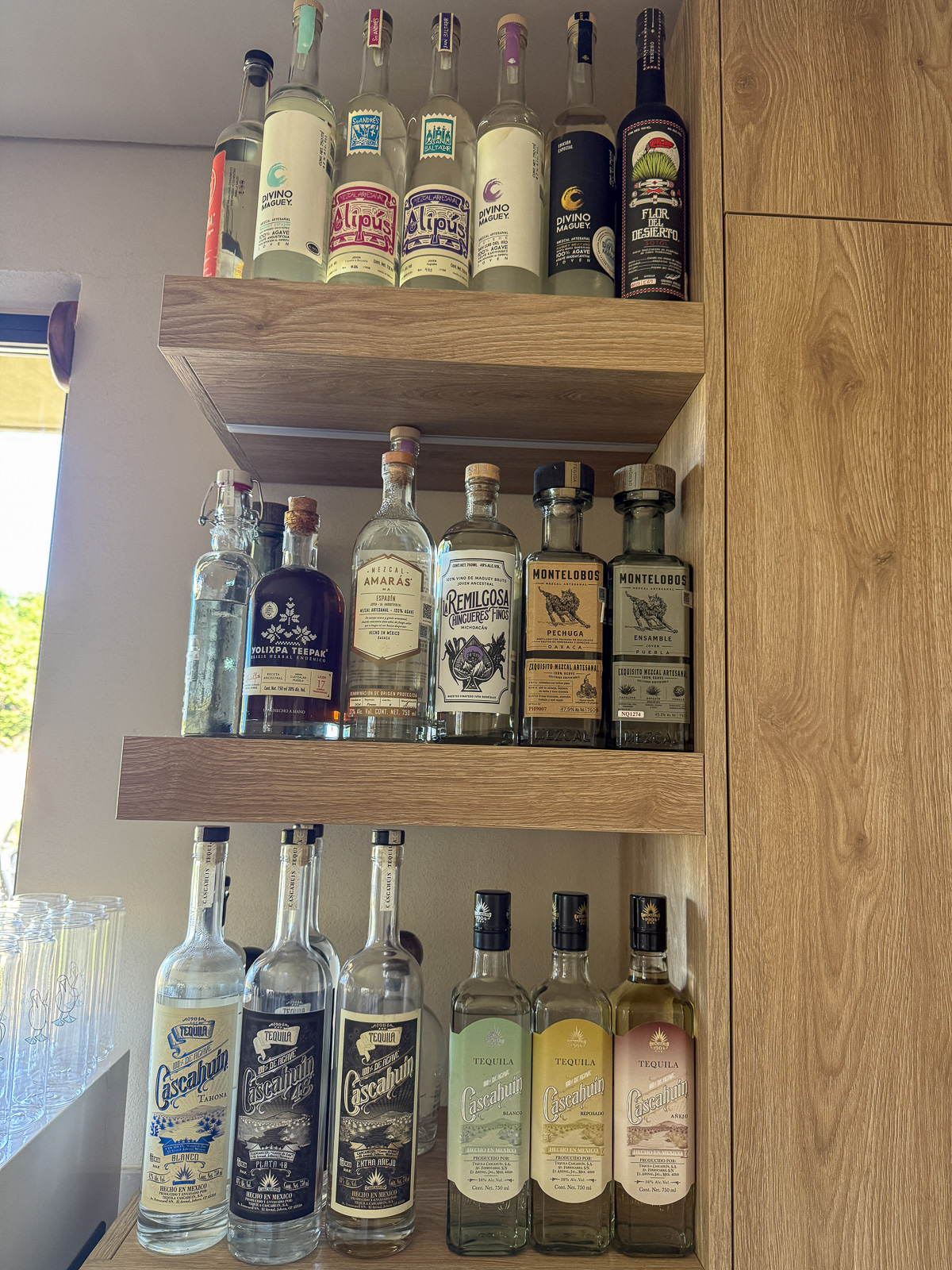
The tequila selection alone is better than most bars you’ll walk into.
And then there’s the Drinks to Go cocktail canning system, which has quickly become one of my favorite signs that you’re at a truly special club. They mix your drink, seal it in a can in seconds, and you’re on your way to the next tee with a cocktail in hand.
The Cascahuin Paloma I had here was one of the best golf cocktails I’ve ever tasted, and will be a new staple for me this Summer.
Beyond the drinks, the Nest has a full food menu coming off the outdoor grill — tacos, quesadillas, and more. But the thing you absolutely have to order is their signature Burgerdilla. It’s exactly what it sounds like: a cross between a cheeseburger and a quesadilla, and it’s spectacular.
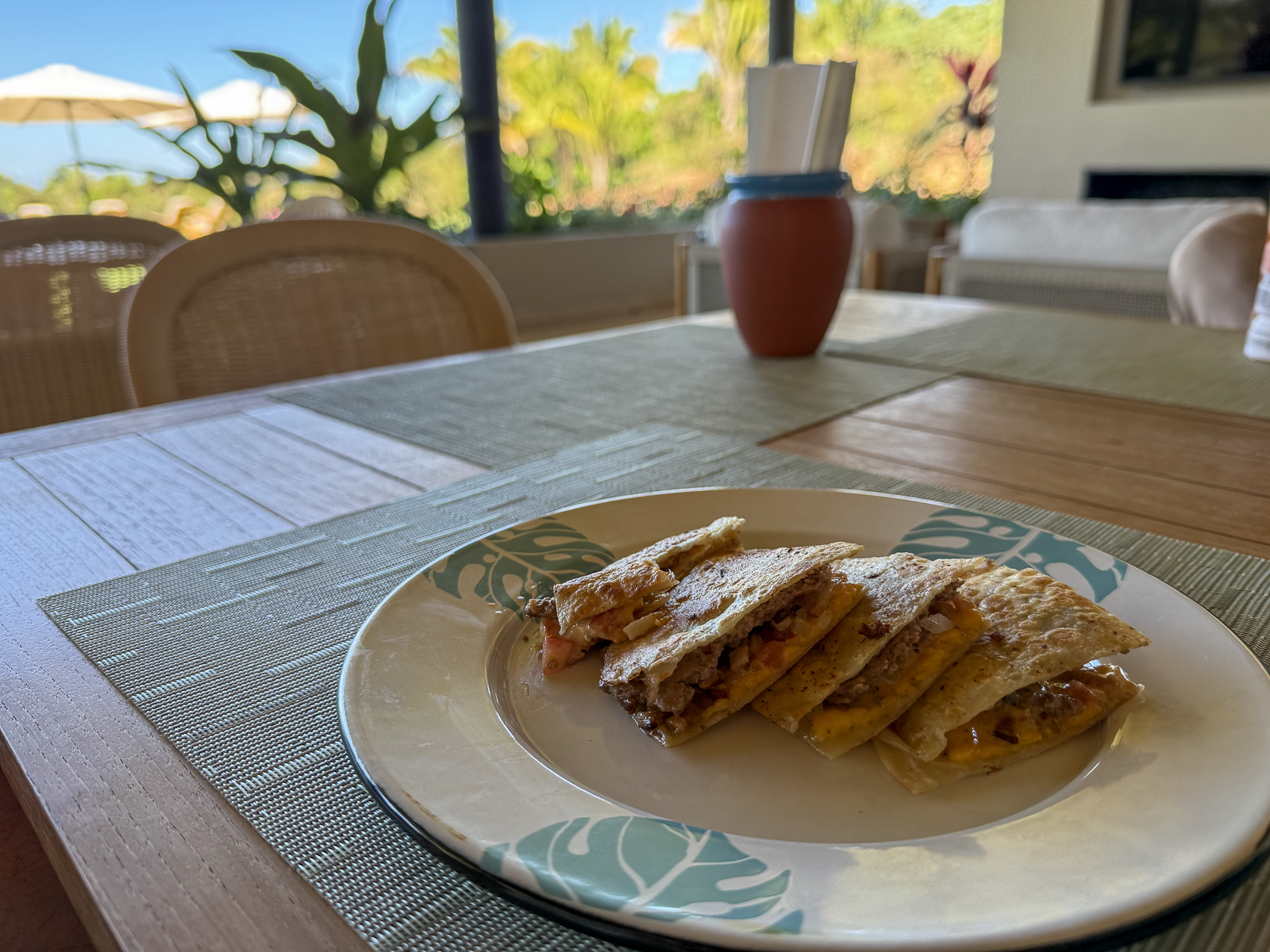
I made the mistake of mentioning in passing that it might even rival the iconic burger dog. A member within earshot shot back immediately: “I don’t know if I’d go that far!”
Fair enough. Order it and decide for yourself.
One more thing worth mentioning: the club is reportedly considering adding a new green between holes 7 and 8, specifically so members can hit shots off the Nest lawn while they’re hanging out up there.
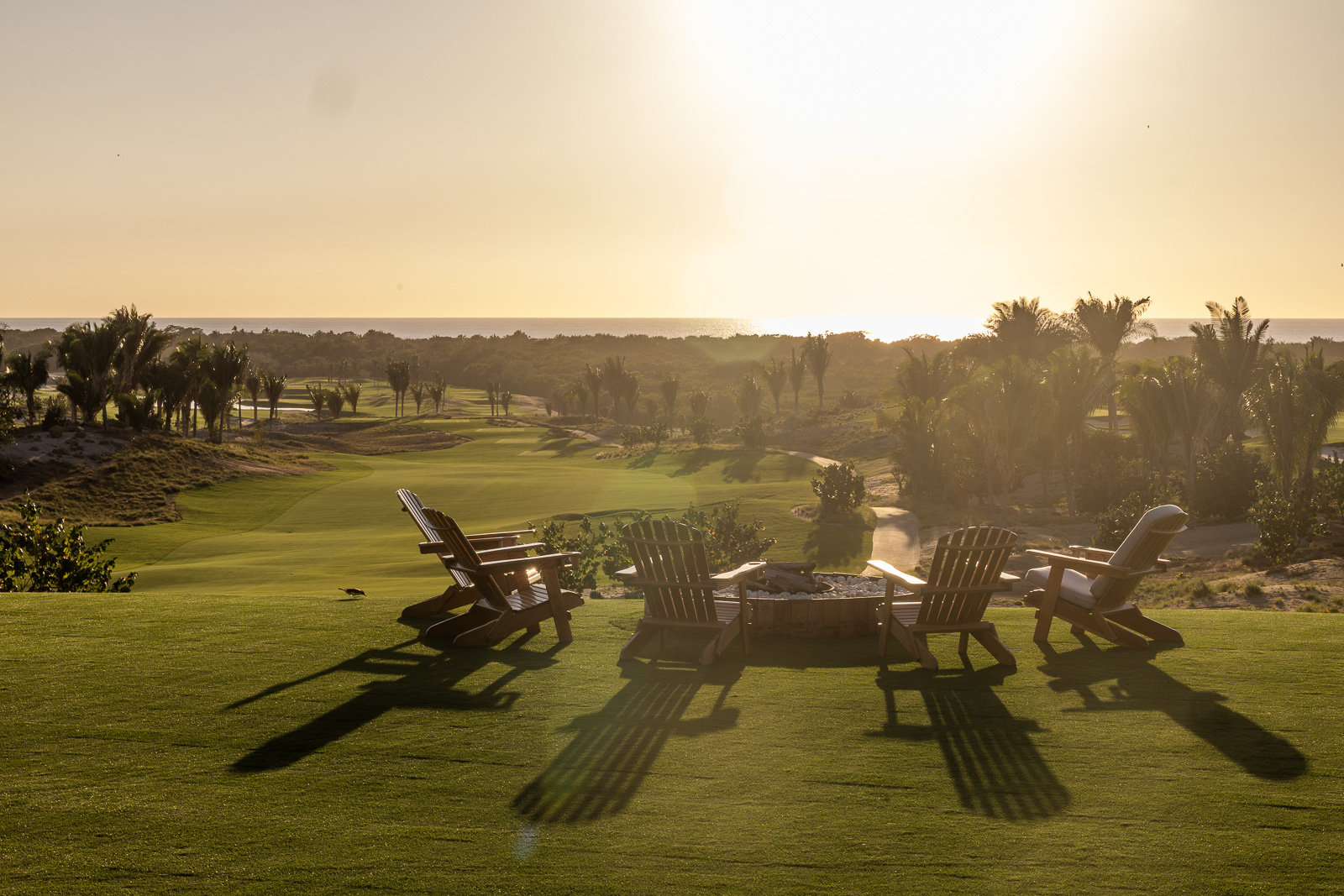
This is the perfect example of what things feel like at Nauka right now. There are big plans, and things are moving quickly.
But if one of the owners has an idea? Plans can change very quickly. It’s this flexibility (and budget) that inspires even more confidence that Nauka will only keep getting better and better.
The Next 5 Holes: A Descent Toward the Mangroves
Leaving the Nest, the course takes you on another seamless transition, this time back down toward the ocean and into a completely different world.
The 8th hole is one of my favorites on the entire course, and it announces itself immediately.
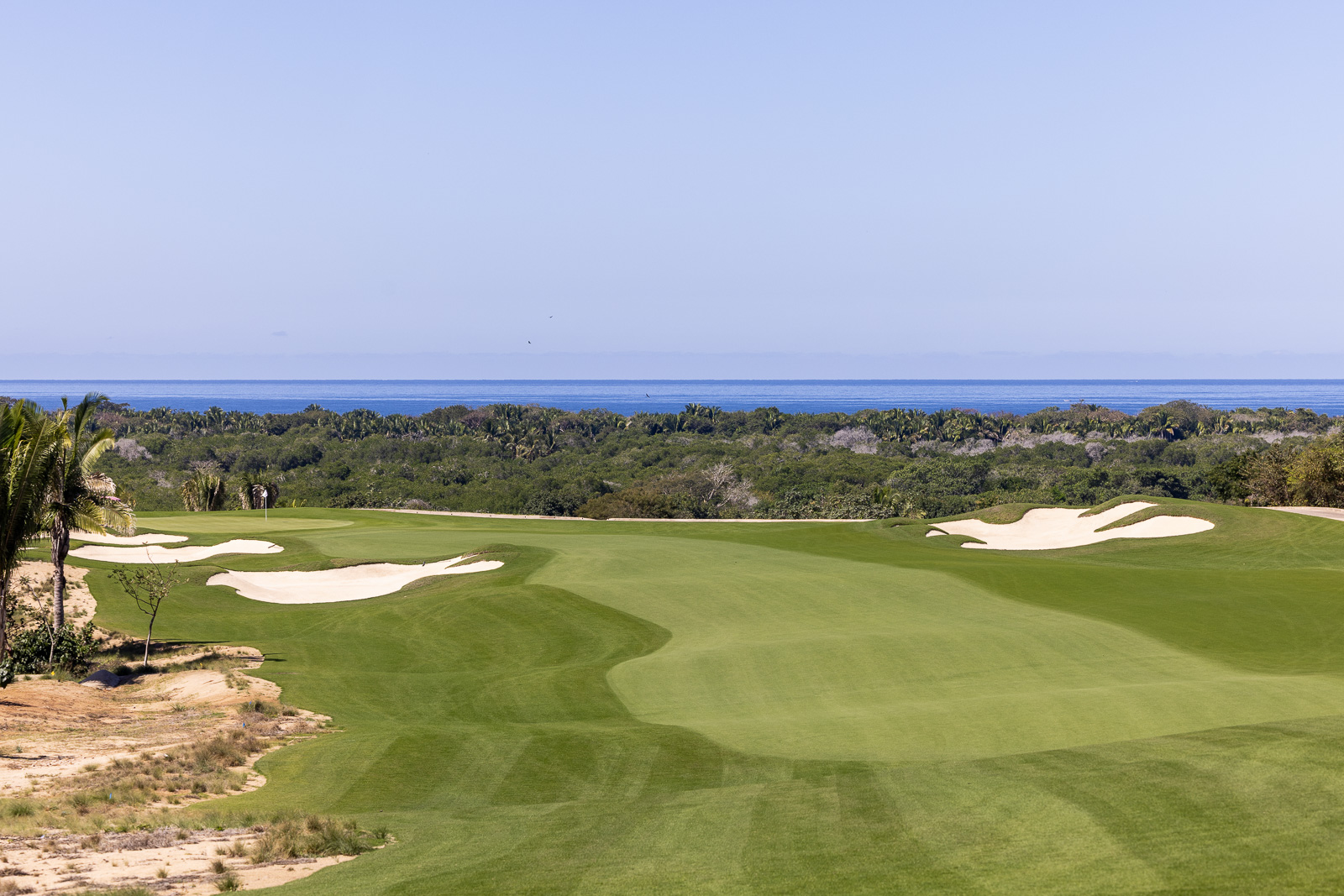
From the tee, you’re hitting downhill back toward the ocean and the clubhouse. Playing from the Tropical Green tees, which play to just under 6,400 yards, this hole measures only 319 yards. But yardage doesn’t tell the story here. I hit my tee shot and watched the ball climb up against the ocean horizon, hang in the air for what felt like forever, and land just 40 yards short of the green. It was one of those pure golf moments you replay in your head for days afterward.
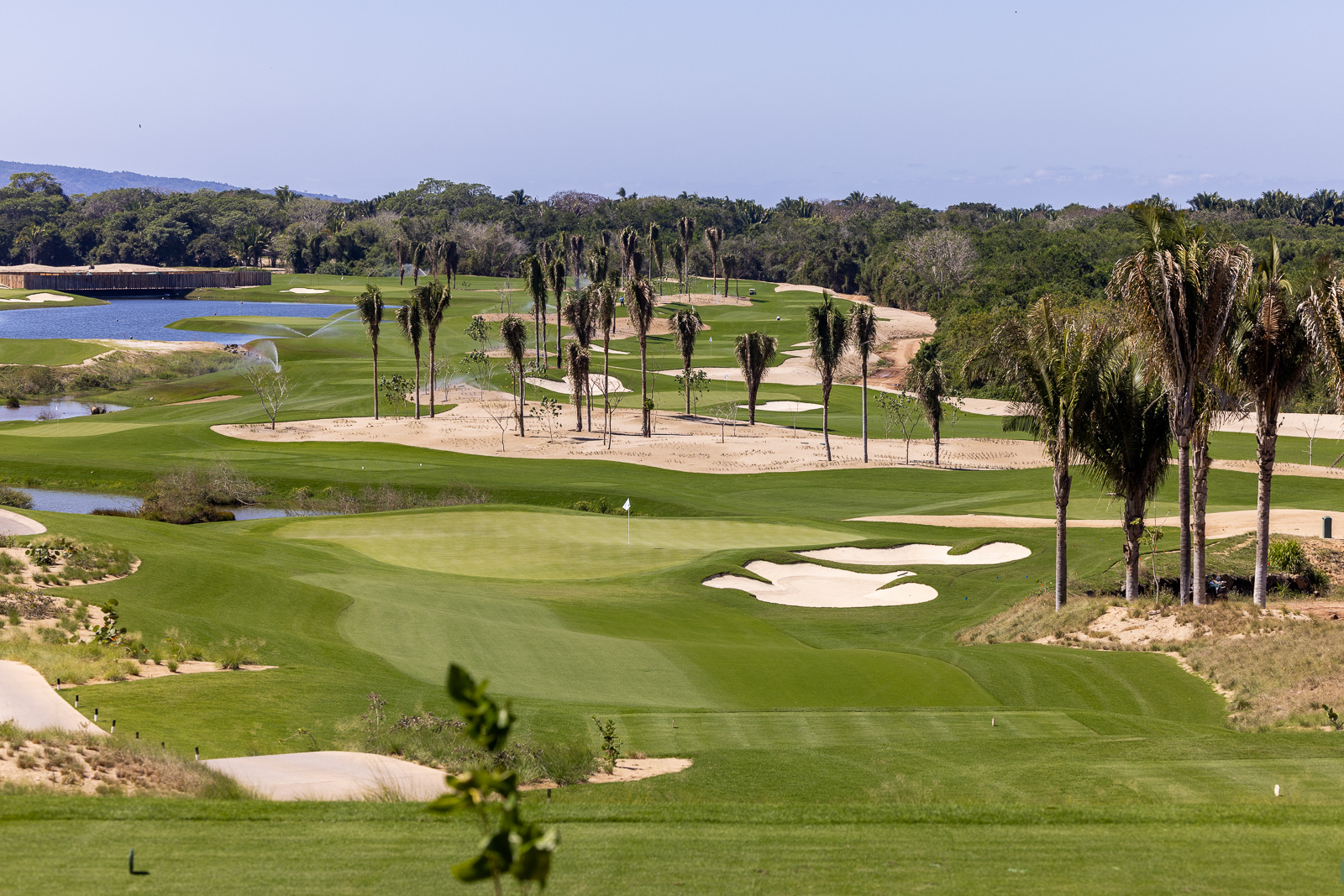
The 9th is a stout downhill par 3 with one of the most interesting green complexes on the course, before the 10th opens things back up with the longest hole on the property and a menu of options depending on how aggressive you’re feeling.
Then comes the shift.
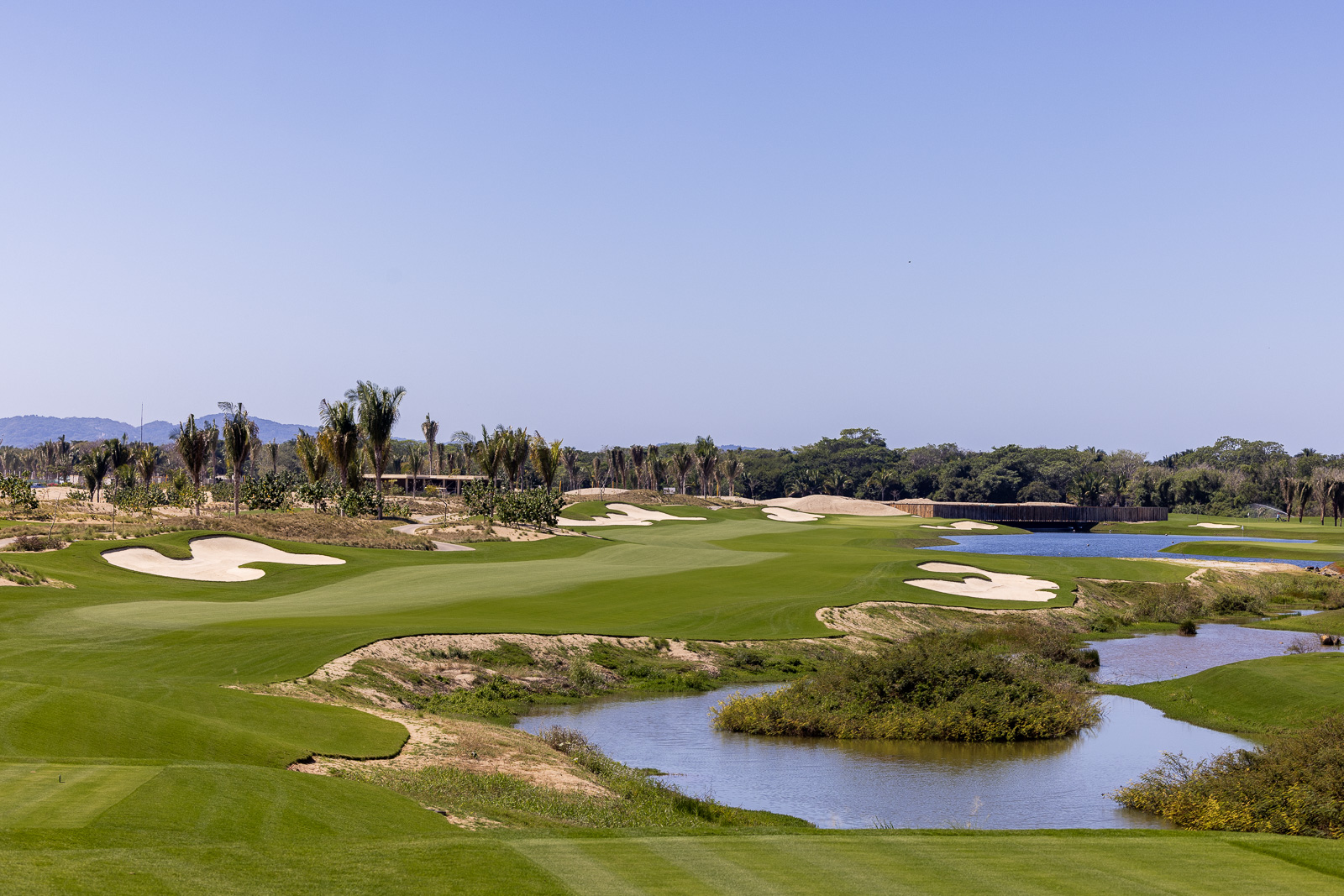
Holes 11 through 13 ease you into the mangrove estuary, and the vibe changes completely. Where the earlier holes felt elevated and expansive, this stretch pulls you back into the earth. The fairways narrow slightly, nothing claustrophobic, but enough to make you think a little harder off the tee. The jungle is closer. The air feels different. It’s the same golf course, but it doesn’t feel like it.
The 11th is a long, demanding par 4 with a slight dogleg right and one of the tougher tests on the course. The 12th is a beefy par 3, and the 13th is a mid-length par 4 that offers just enough of a break to catch your breath.
You’re going to need it.
La Panga: The Final Comfort Station
After a short cart ride off the 13th green, you arrive at the back tee of the par-3 14th. And before you even think about club selection, stop and take it in.
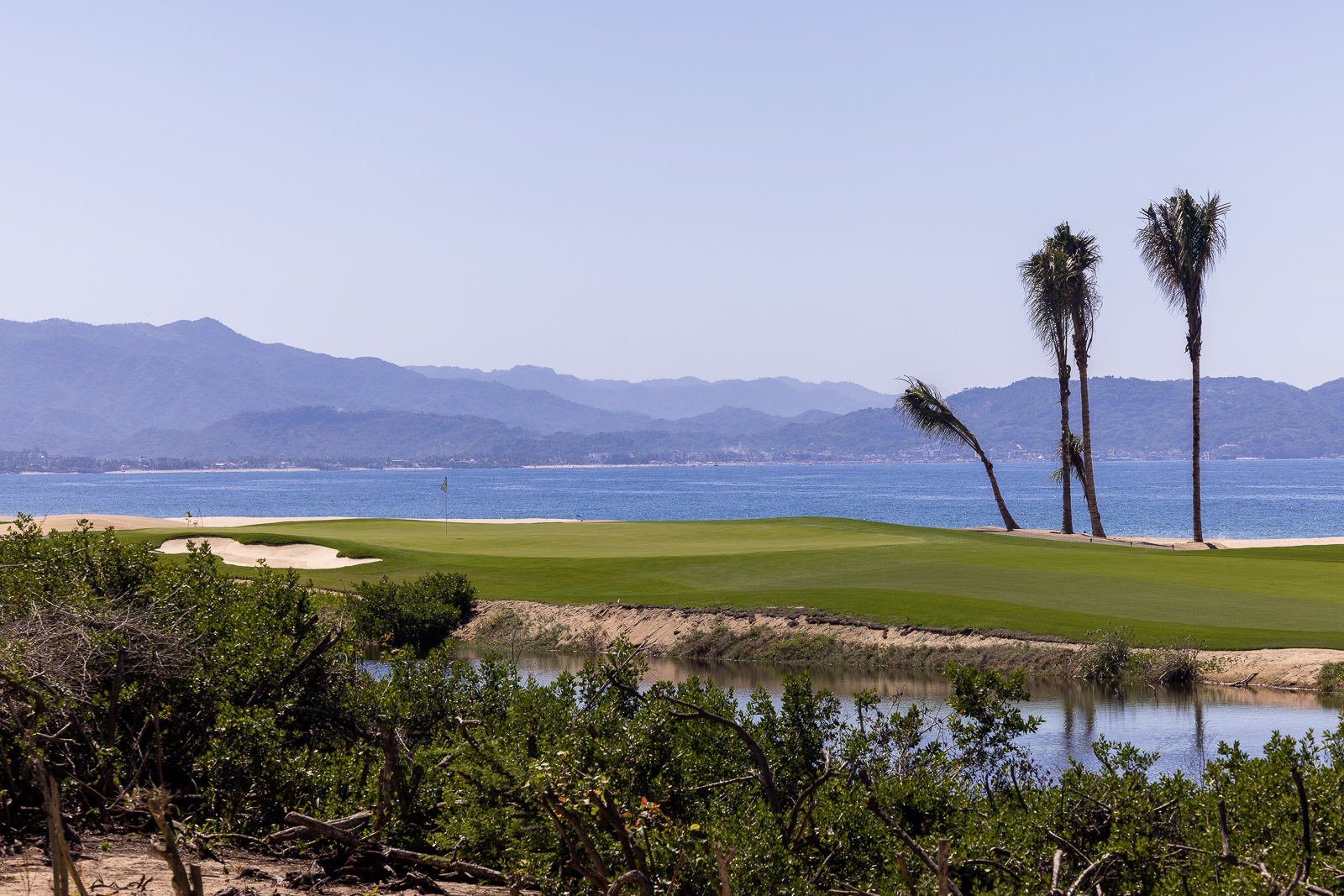
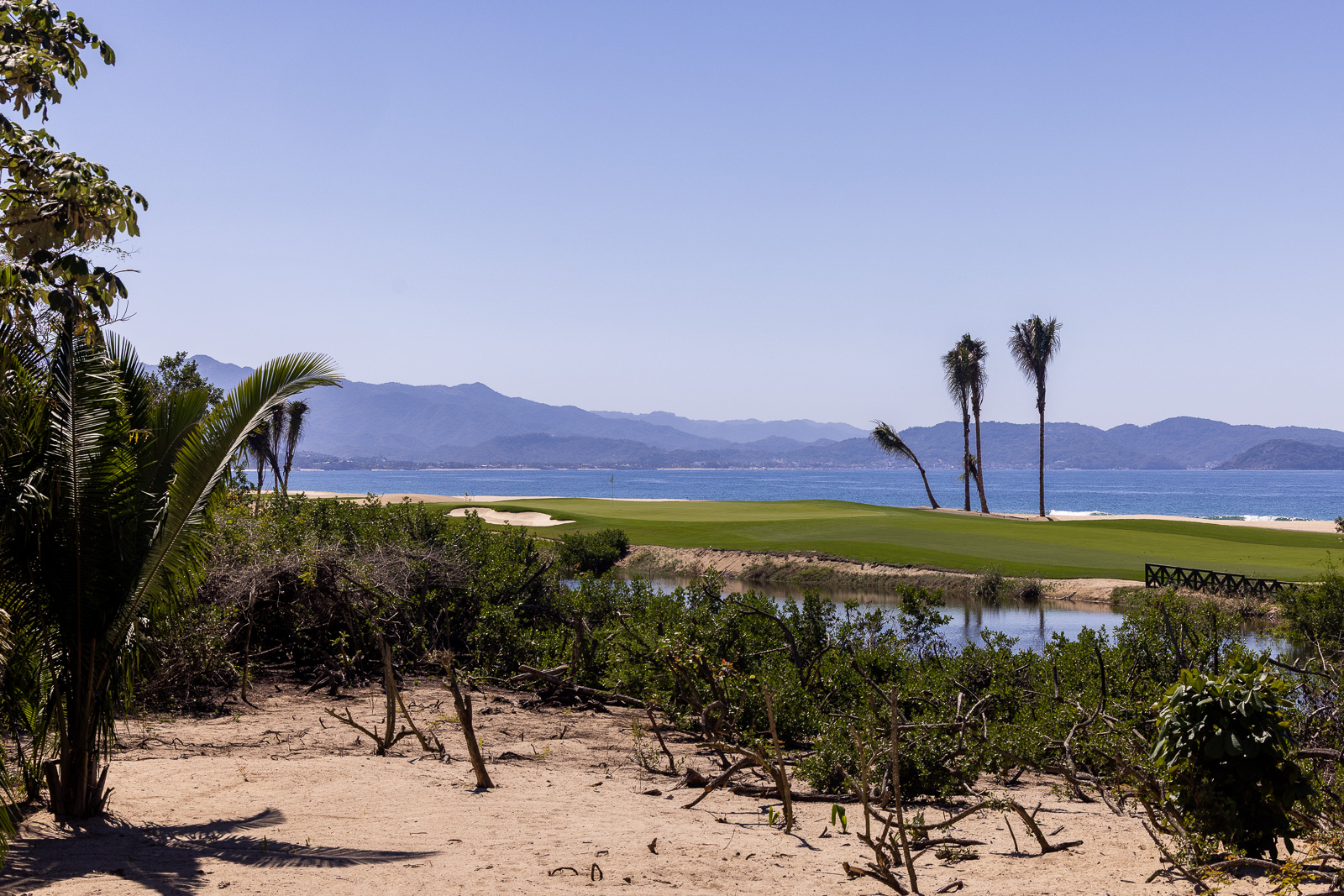
You’re hitting over the mangrove estuary to a green backed by the open ocean, with mountains rising in the distance beyond. It’s beautiful, memorable, and genuinely thought-provoking. This is one of the best individual shots on the entire golf course.
But here’s where things get interesting.
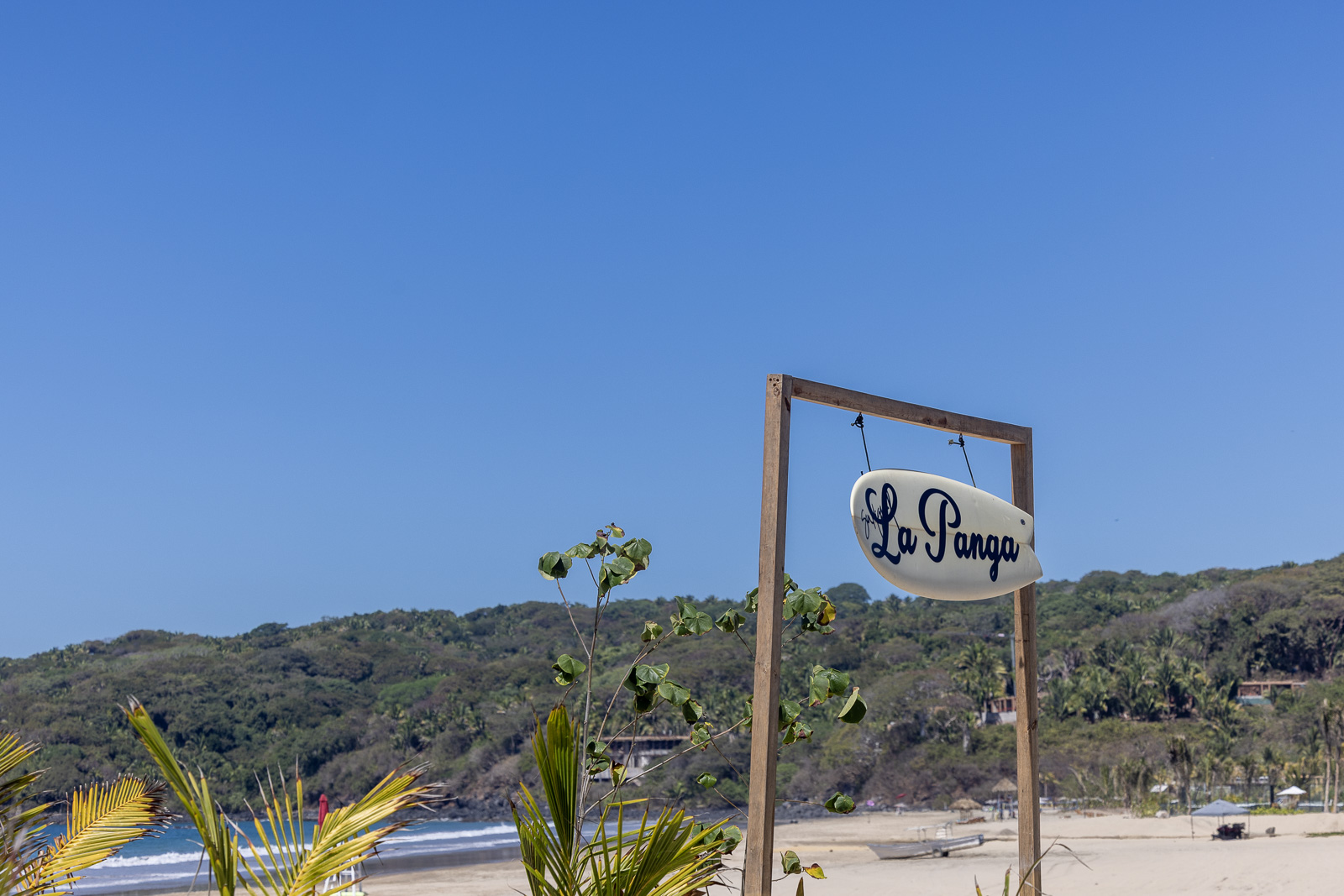
After you play your tee shot on 14, you make a 90-degree turn, cross a bridge, and find yourself greeted by a surfboard that simply reads: La Panga.
If the Nest is the social hub of the front half, perched at the highest point on the course and buzzing with energy, La Panga is its perfect counterpart. It sits at the lowest point on the property, right at the water’s edge, and the vibe is something closer to a secret beach bar than a golf comfort station.
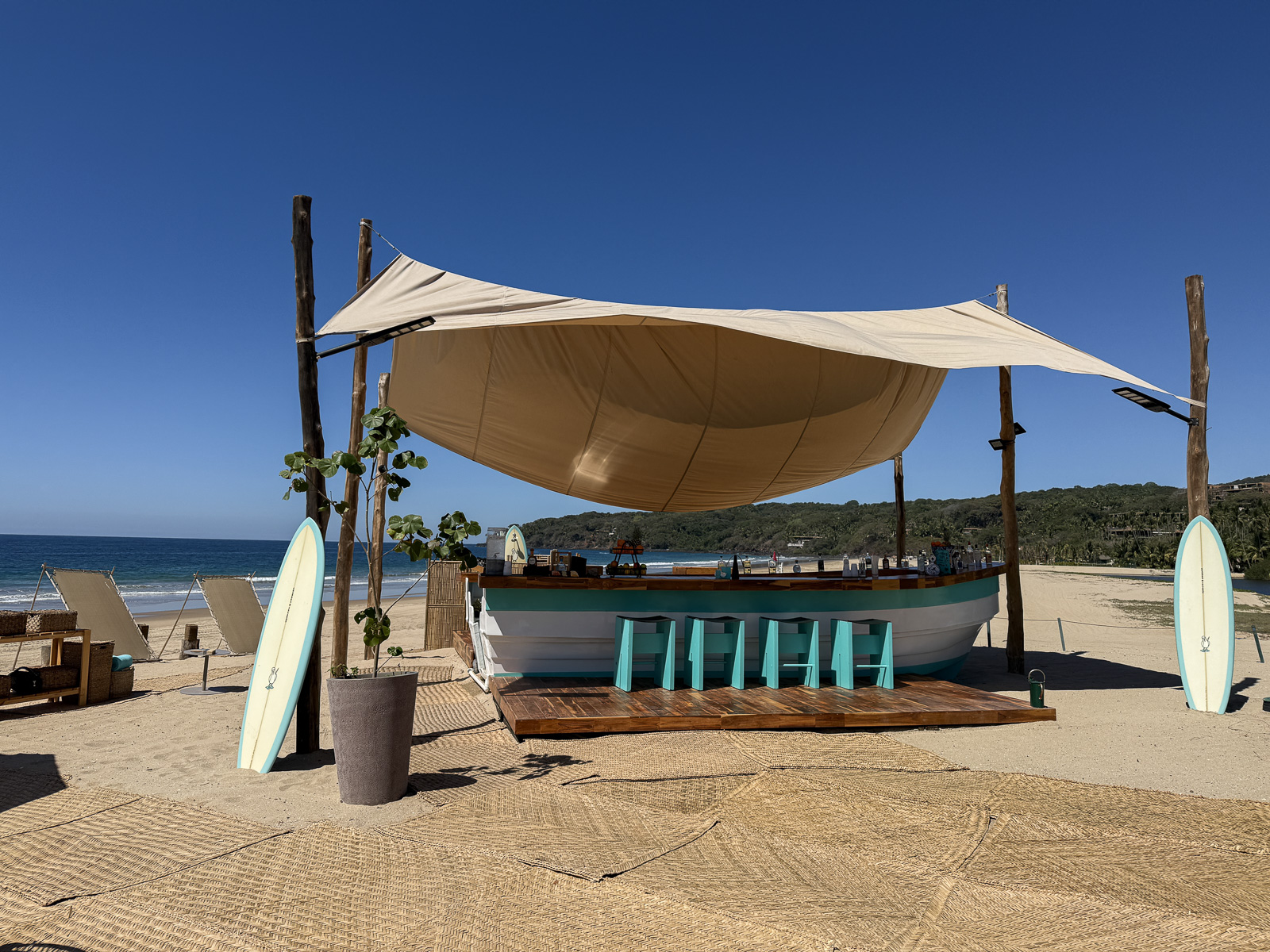
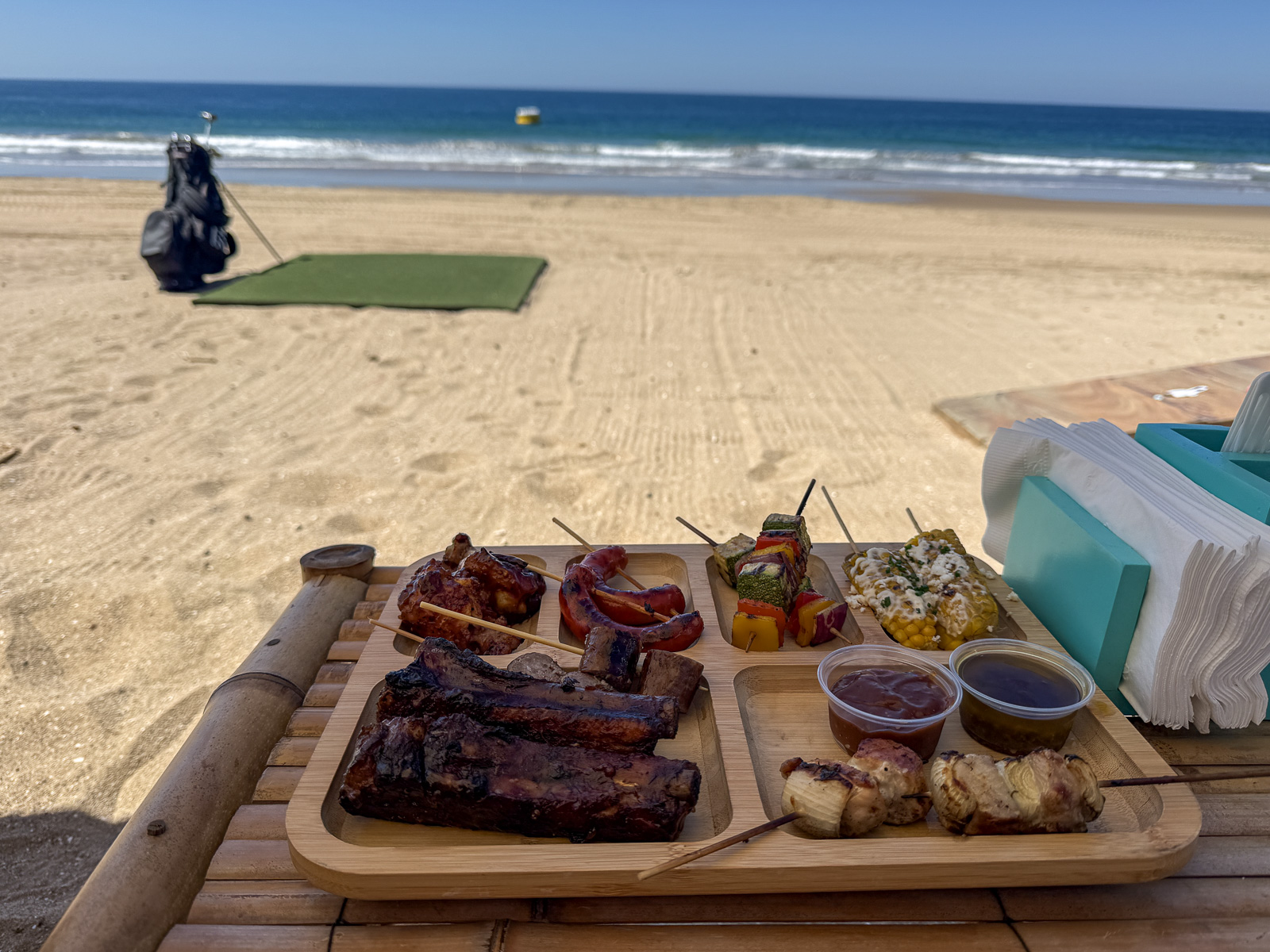
There’s a smorgasbord of grilled meats waiting for you. A full bar built inside a boat, which is where the name comes from. Hammocks. Water. Quiet.
And it’s perfectly normal here to hit your shot on 14, pull up to La Panga, grab some food and a drink, take a swim, and not think about putting out on 14 for an hour or two.
Kyle summed it up perfectly: “I’ve seen rounds here take just 2.5 hours, and I’ve seen rounds happily last 9 hours. Both equally enjoyable and totally unique experiences.”
I could have stayed at La Panga all afternoon. I genuinely mean that.
During my time at Nauka, I only crossed paths with one other golfer at La Panga. He was friendly, relaxed, clearly right at home. It was here he looked at me, half joking and half completely serious, and made his request: “Don’t tell everyone about this place. I’m hoping for a couple more years like this!”
Standing there in one of the most unique spots the world of golf has to offer, I knew exactly what he meant.
The Finishing Stretch: Holes 14 through 18
I’ve played dozens of courses along the water. Links tracks perched on clifftops in Bandon or Scotland. Coastal courses where the ocean is a constant presence in the background.
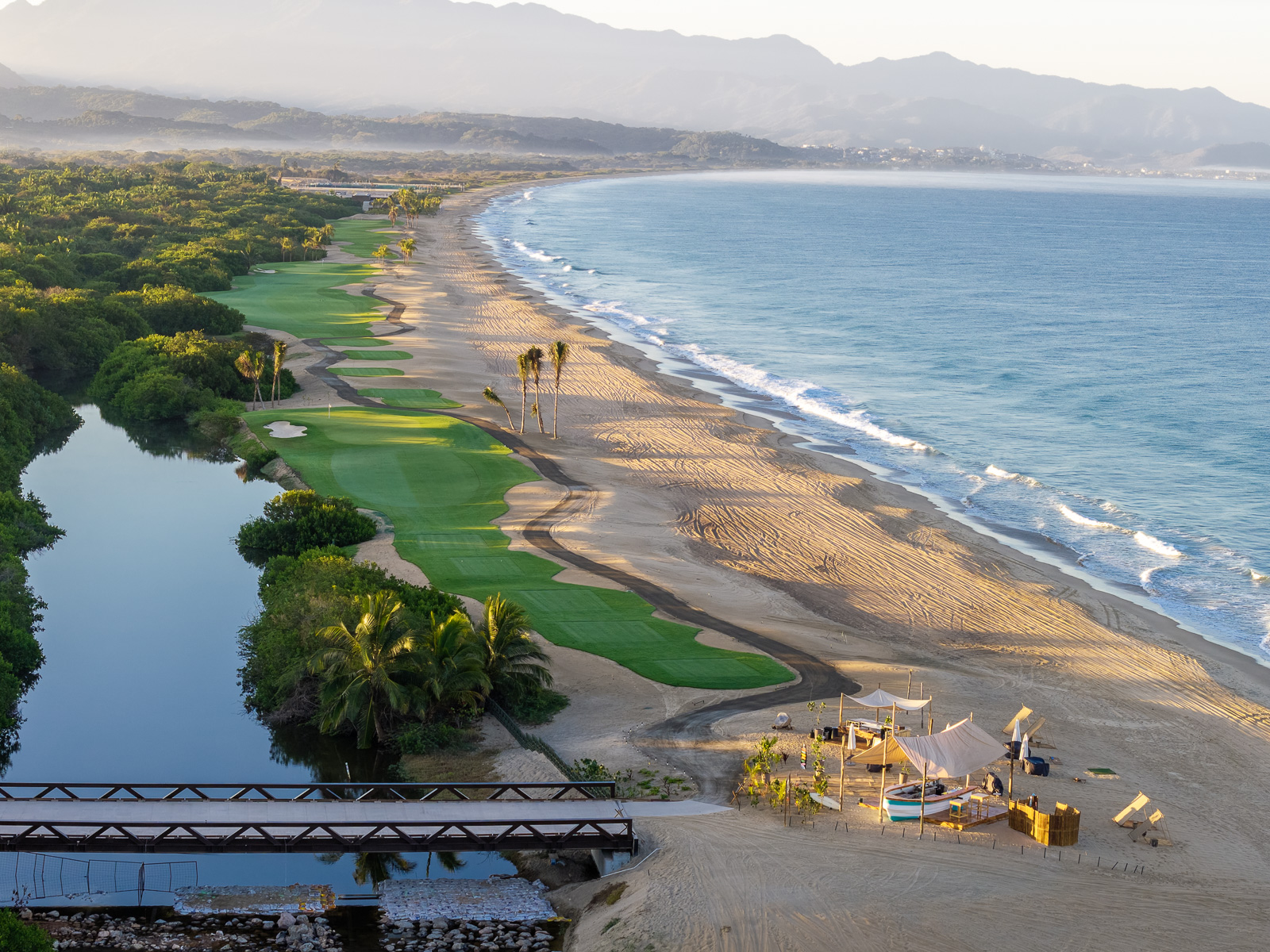
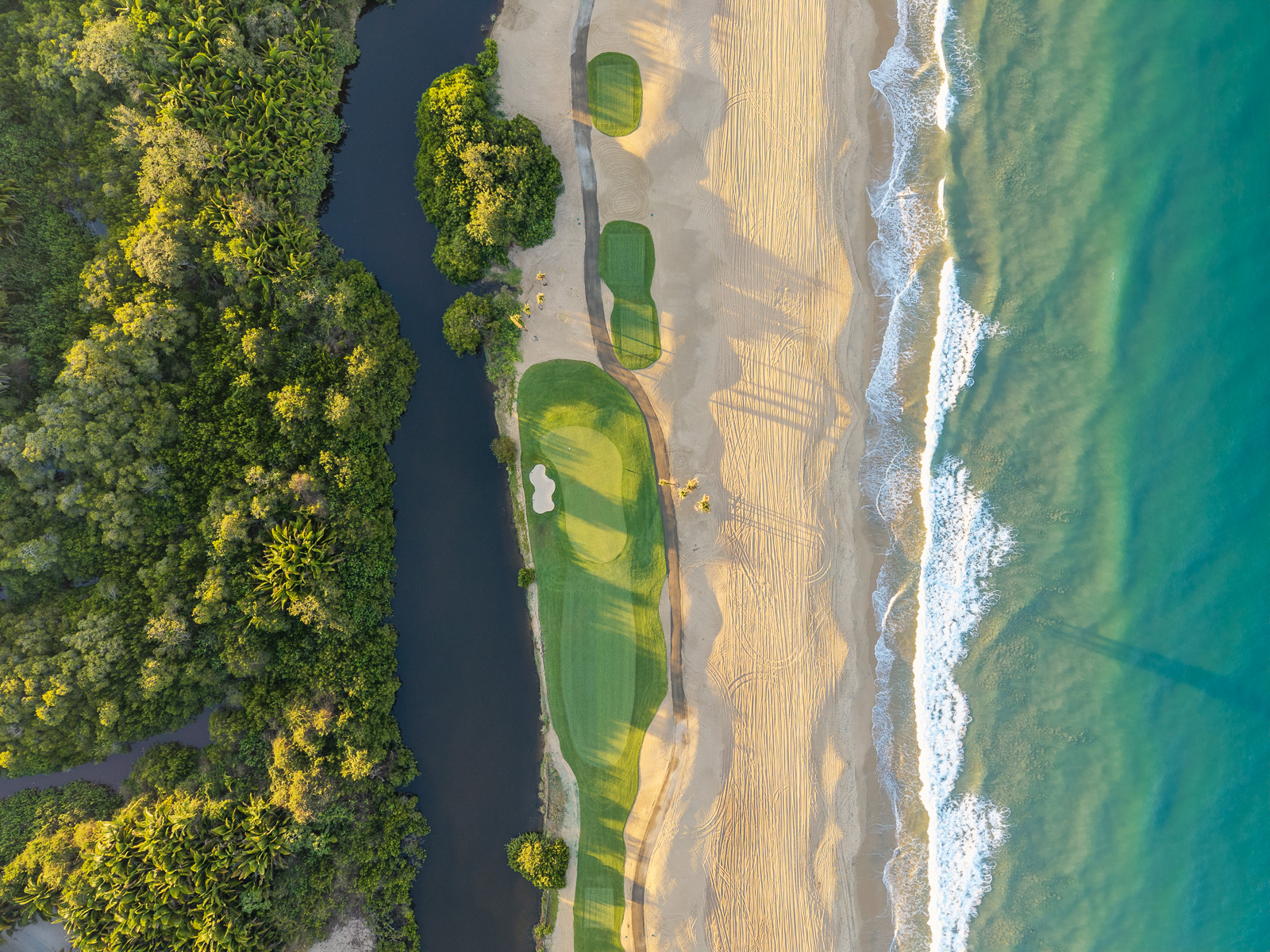
Yet, I have never played three consecutive holes that feel like they were literally built directly on the beach.
Holes 14 through 16 are the centerpiece of the course, and they’re made possible by one of the more remarkable construction stories in modern golf course architecture.
When the team was excavating the forthcoming marina on the property, they dug out 60 million cubic feet of sand. Rather than haul it away, Fazio’s team used it to sand cap the entire course to a depth of five feet. Five feet. That likely makes Nauka one of the best draining courses anywhere in the world, but it also explains how three holes could be built running directly parallel to the Pacific with nothing but beach between you and the breaking surf.
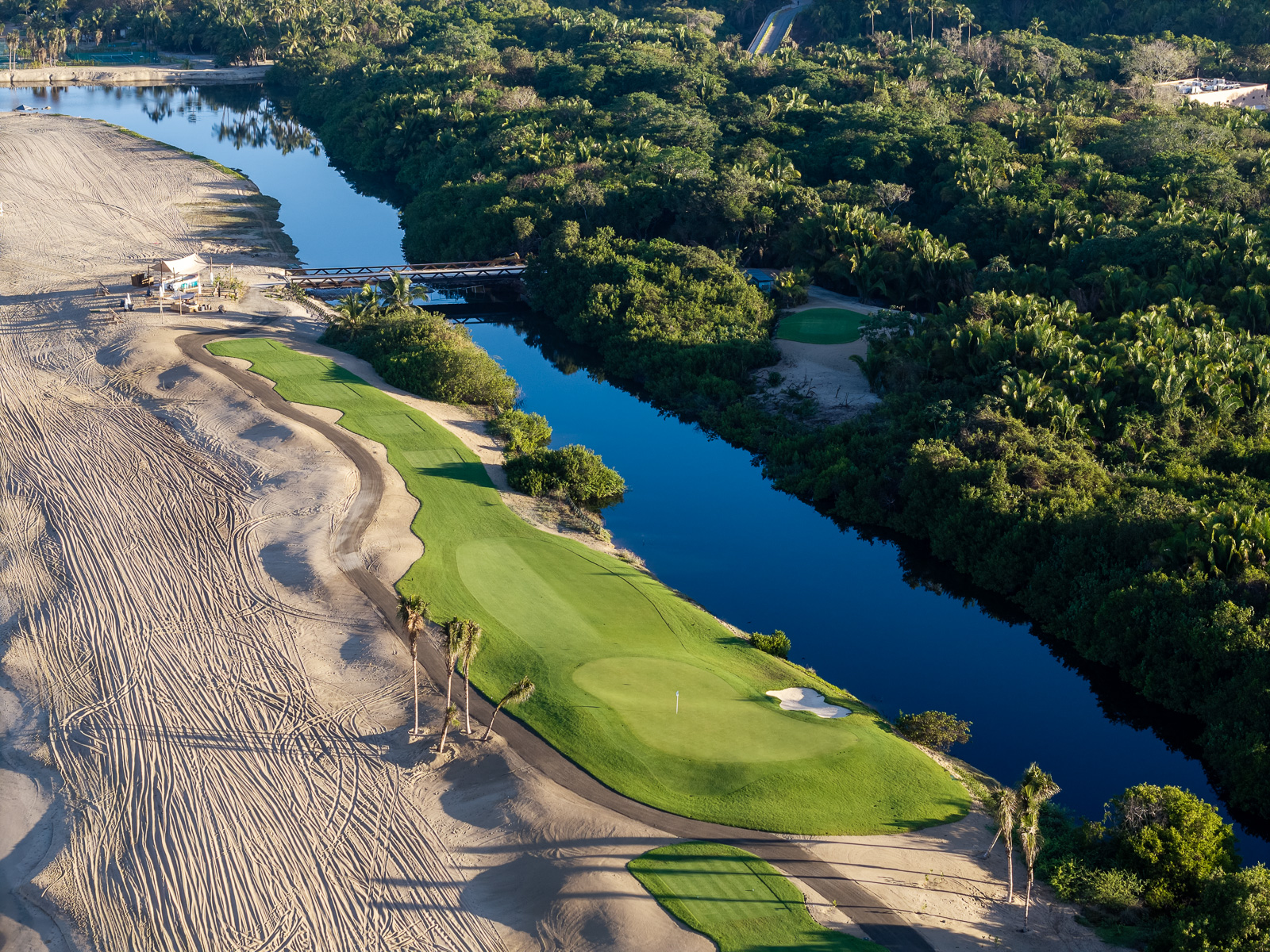
It’s worth noting that this stretch is still a work in progress. The trees behind the 14th green were planted just weeks before I arrived. And I heard from several people on the property that the 16th may see some tweaks down the road to give it a more distinct identity from the 15th. But as it stands right now? These holes are wildly fun to play, and the potential for what they could become is genuinely exciting.
Then comes 17, which might subtly be the best hole on the entire course.
It’s a slight double dogleg par 5 that bends right before turning back left toward the green. The aggressive play is to fade a tee shot around the trees on the right, opening up a better angle for your second shot. But at 601 yards from the tips, it’s a three-shot hole for all but the longest hitters. It rewards patience, punishes overconfidence, and gives you something to think about on every shot.
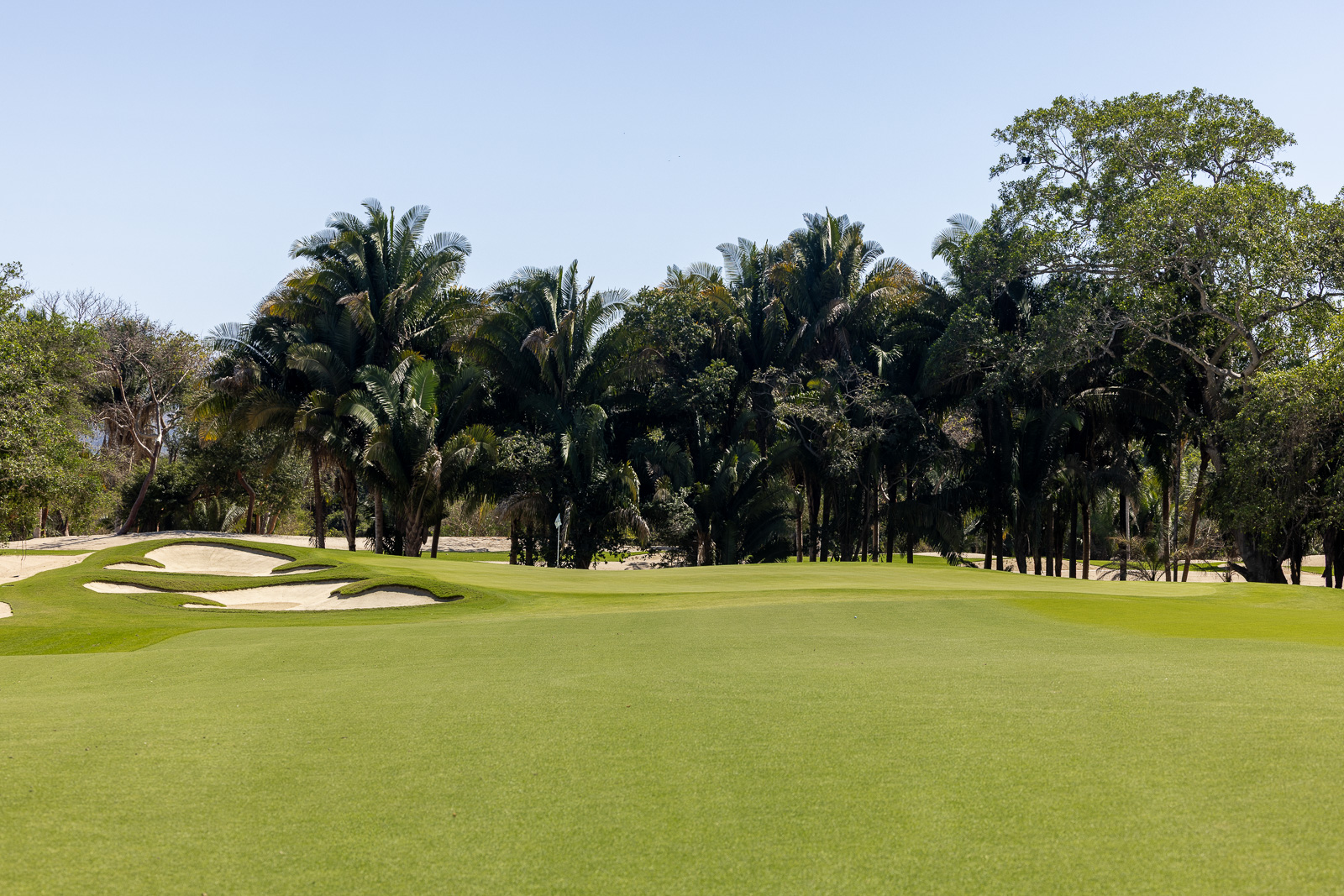
It was also on 17 that I had what should have been the most memorable moment of my first round:
I holed out for Eagle from 75 yards.
Yet somehow, that moment doesn’t even crack the top 3 most memorable moments. That tells you all you need to know about how unique this golf experience is.
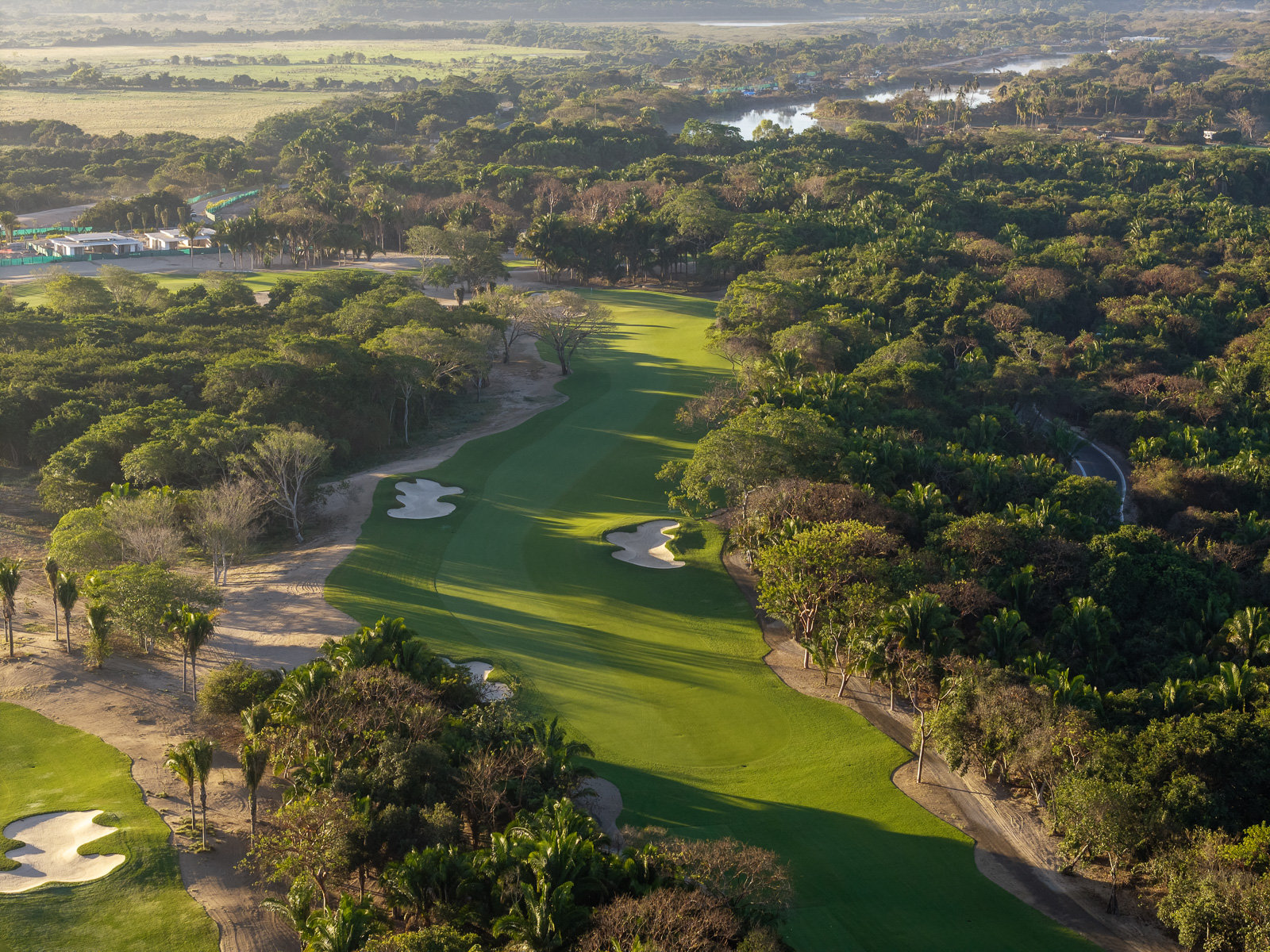
The 18th finishes with a demanding dogleg left par 4. Coming down the stretch, I knew I had a solid round going, and if I could just hold it together, I was looking at a genuinely good score. I found myself in the native grass left off the tee, but still had a clear 145-yard shot at the green.
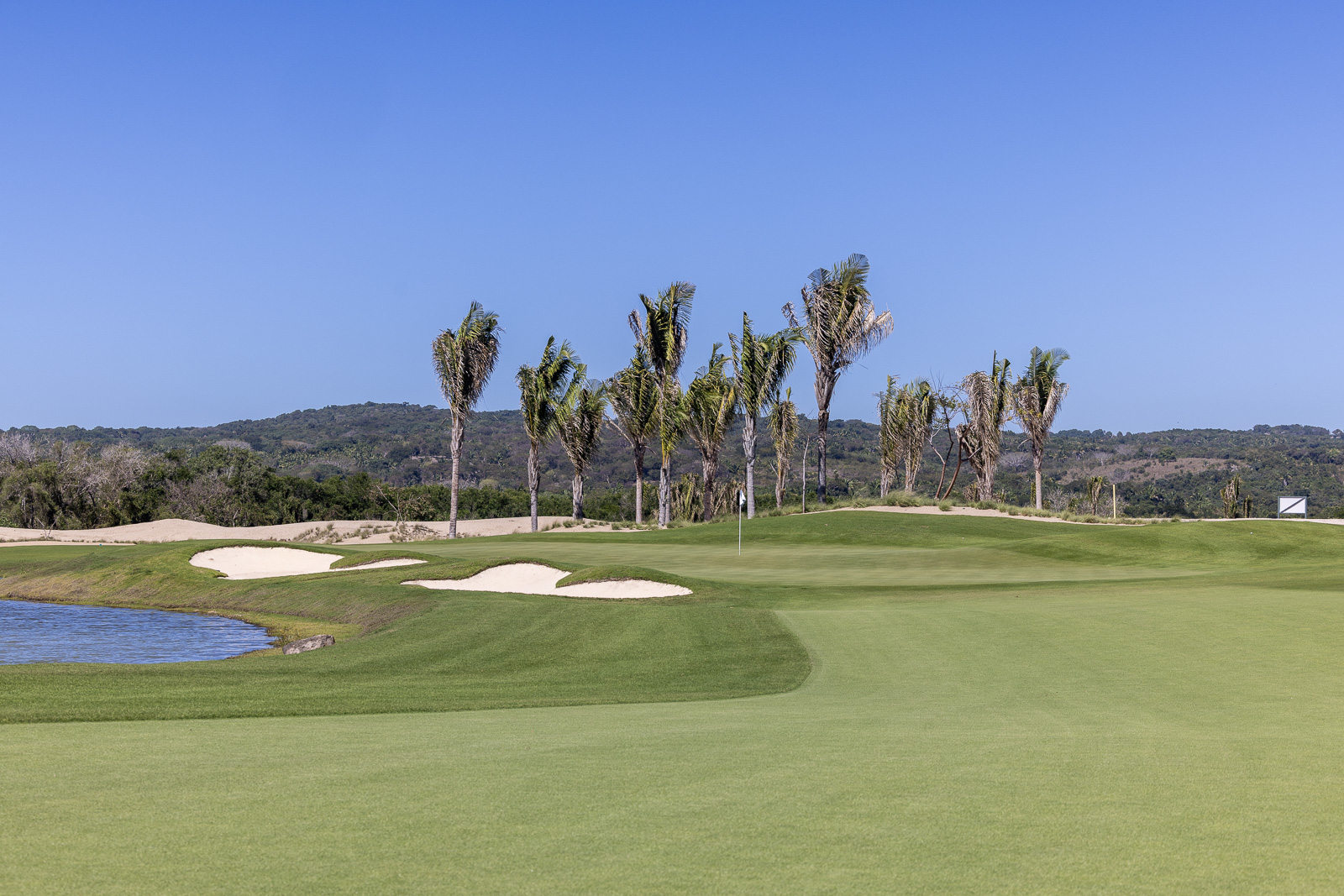
A few mental lapses later, I was signing for a double bogey and an 81.
Didn’t quite live up to the Breaking Eighty name today.
But honestly? It didn’t matter, as this is a round I’ll be thinking about for a very long time to come.
The Booby Trap Par 3 Course

Few clubs I’ve encountered do a better job of building a brand around their sense of place than Nauka.
A few miles off the Nauka coastline sits Coral Island, one of the only places in the Northern Hemisphere where you can find the Blue-footed Booby bird. We actually got out on the water during our stay to visit the island and see them up close, which was one of the more unexpected highlights of the trip. More on that shortly.
It’s from this bird that Nauka draws its logo, and where its nine-hole par 3 course gets its name: The Booby Trap.
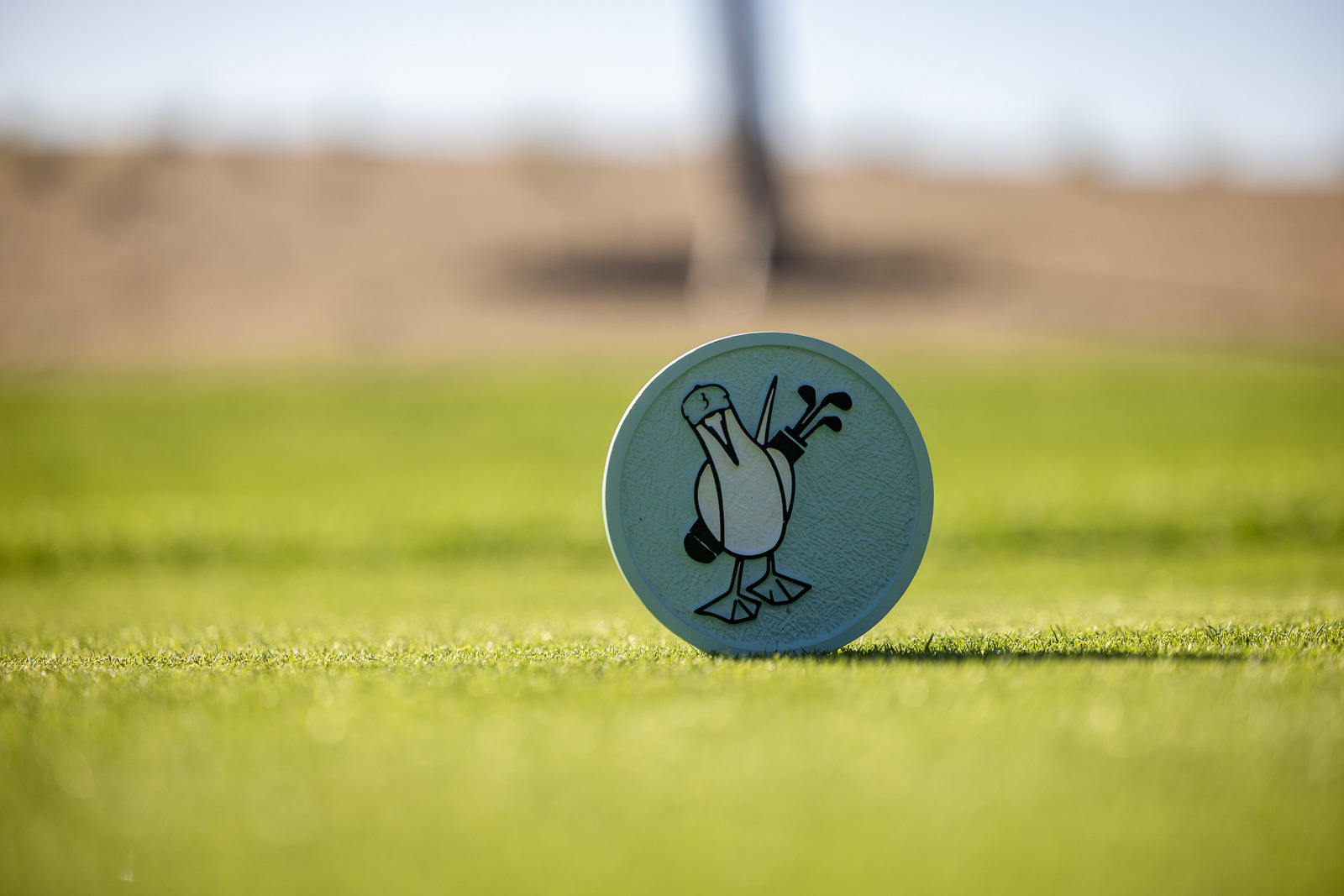
This is the perfect complement to the main course. It’s walking only, with a tree of Sunday bags waiting at the first tee for you to grab a few clubs and head out at your own pace. There’s no formality here, no pressure. Just a fun, breezy loop through a beautifully maintained layout that’s as enjoyable for a 10-year-old as it is for a scratch golfer looking to work on their game.
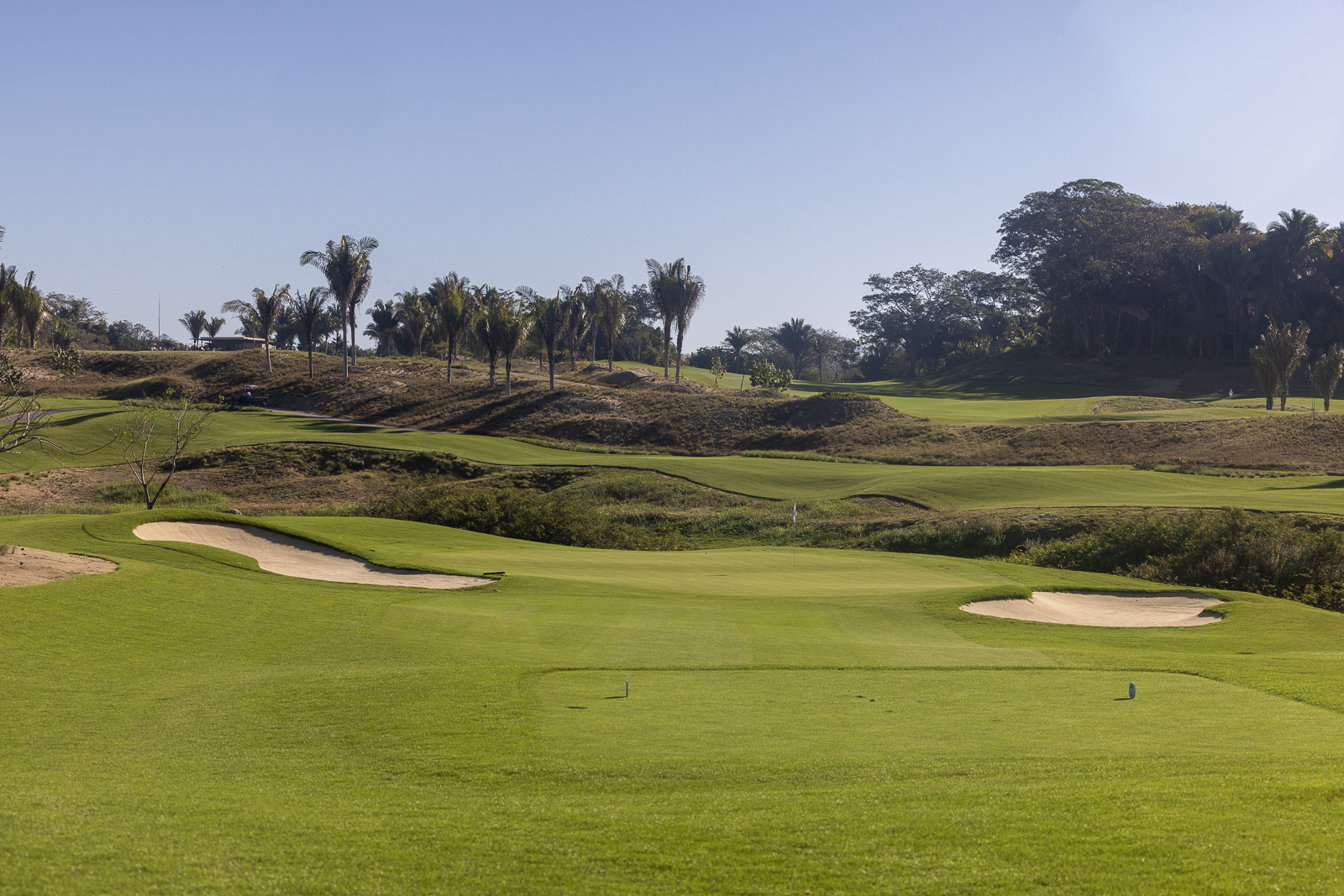
It’s not an overly challenging course, which is exactly the point. There are anywhere from 2-4 teeboxes per hole, but the design was built with more of a choose-your-own-adventure mentality in mind. Play from wherever you want. Mix it up. Hit it from 60 yards one day and 160 the next. Bring your kids. Bring your parents. Have a beer and take your time.
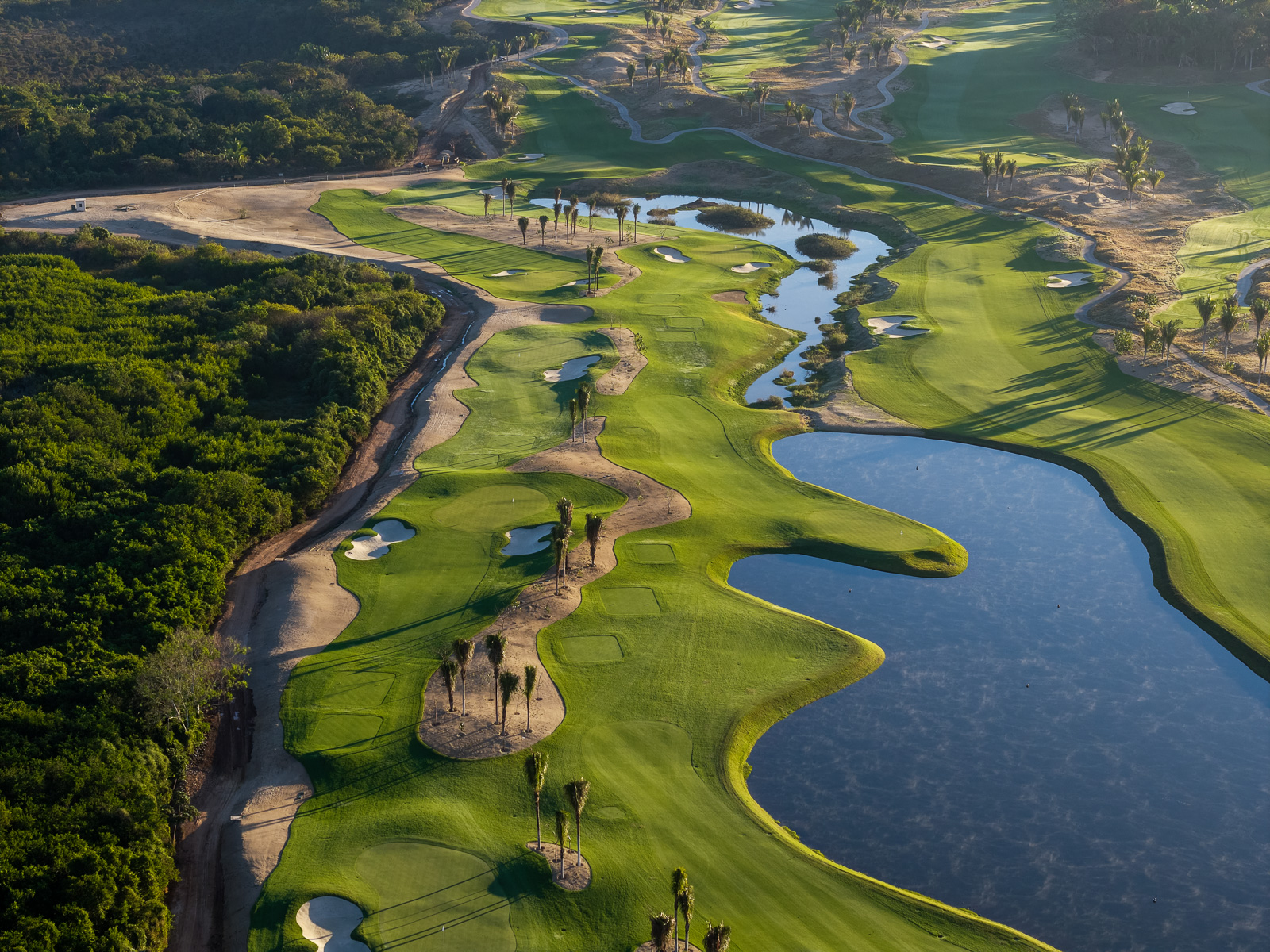
The Booby Trap captures something essential about what Nauka is trying to be: a place where golf doesn’t have to be serious to be special.
The Village at Nauka
Step out of the jungle path and into the Village, and the whole thing opens up in a way that genuinely catches you off guard.
This is the heart of Nauka, and it feels like it.
To one side, you have an open-air hale with couches, lawn games, and the kind of laid-back gathering space that makes you want to plant yourself for a few hours and not move.
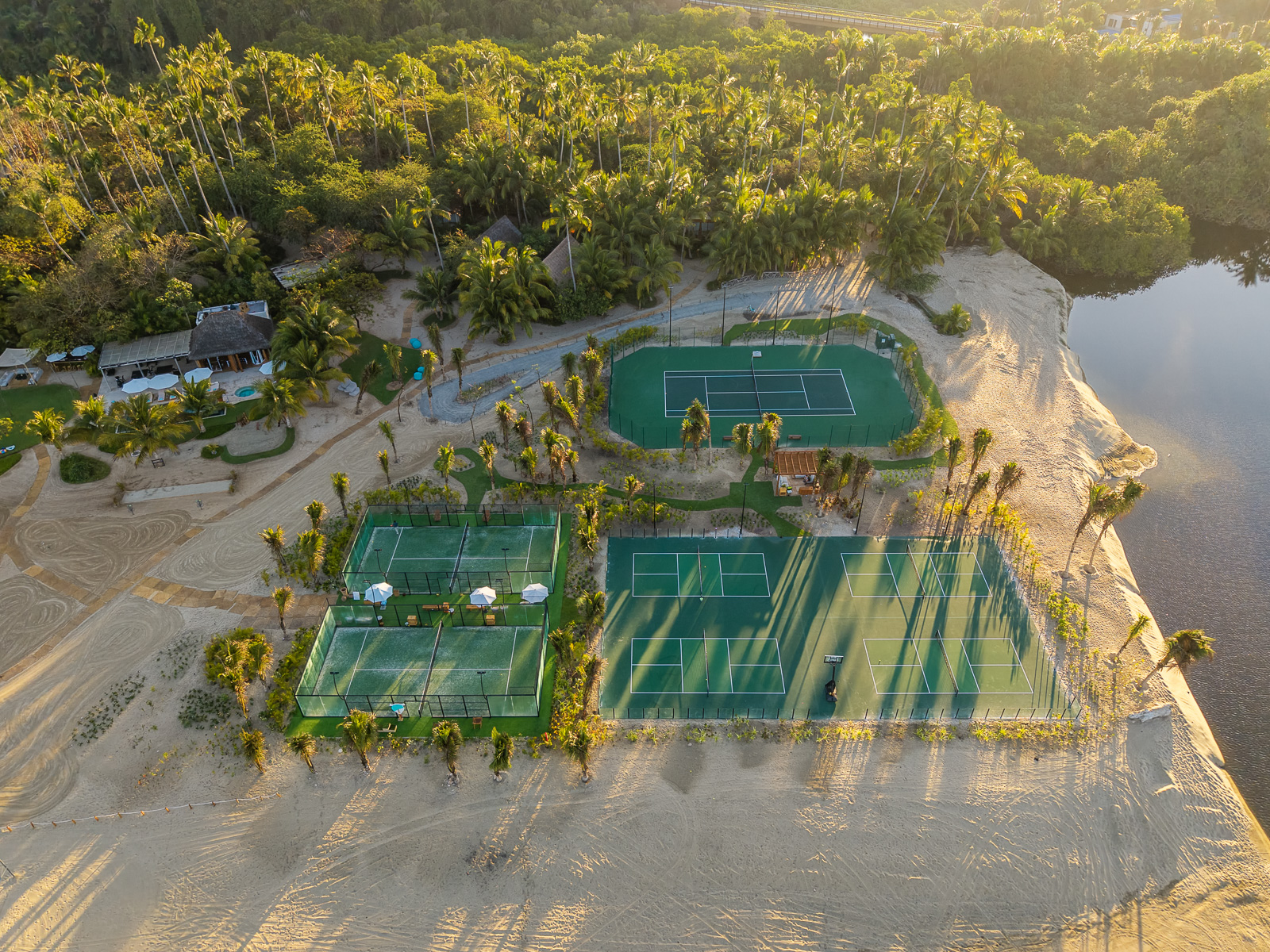
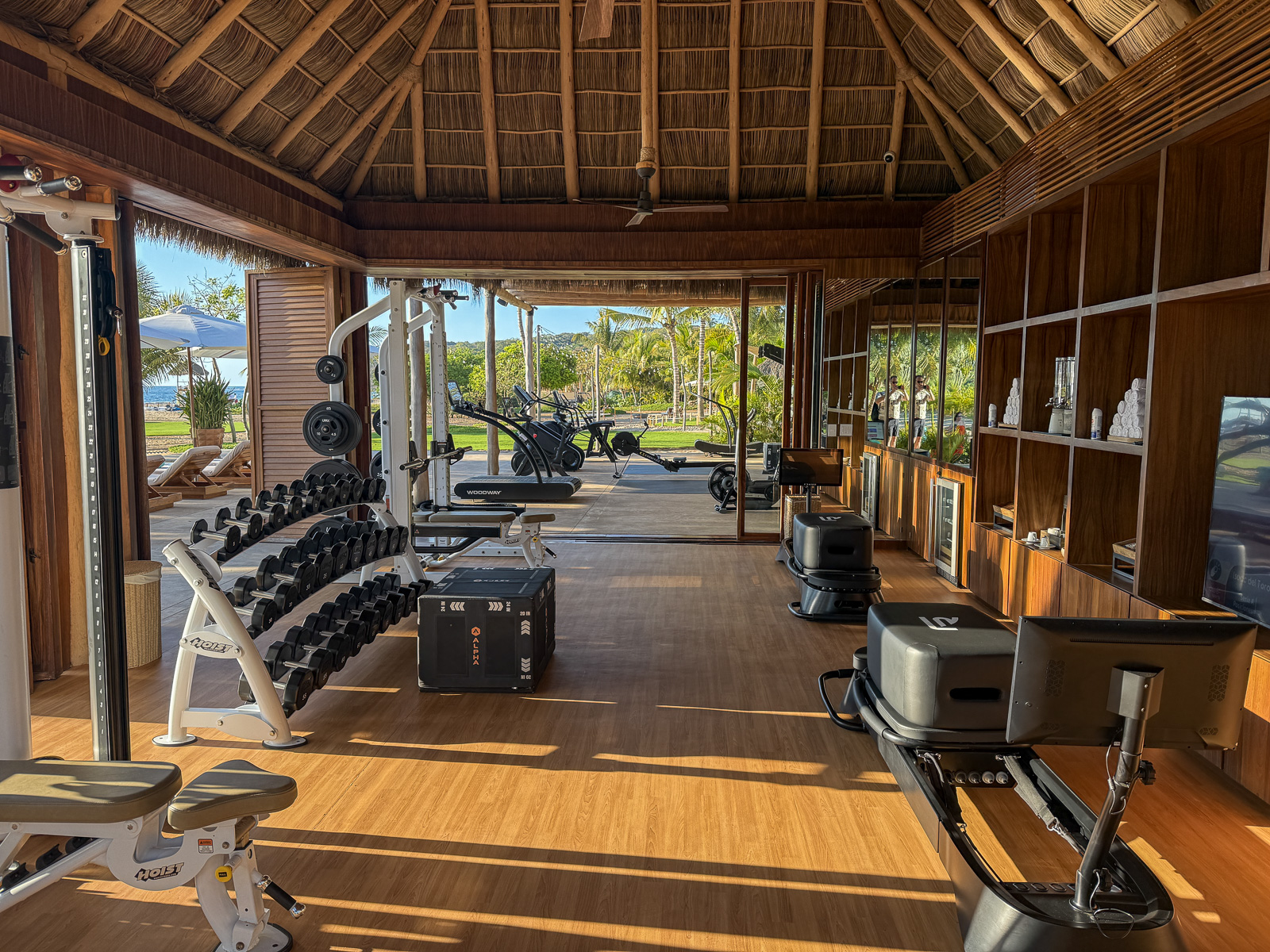
On the other side, there’s a beach bar, a fully stocked outdoor gym, a small pool and hot tub, and what might be the most scenic set of sports courts I’ve ever seen: tennis, basketball, pickleball, and padel, all right on the beach with the Pacific Ocean as your backdrop.
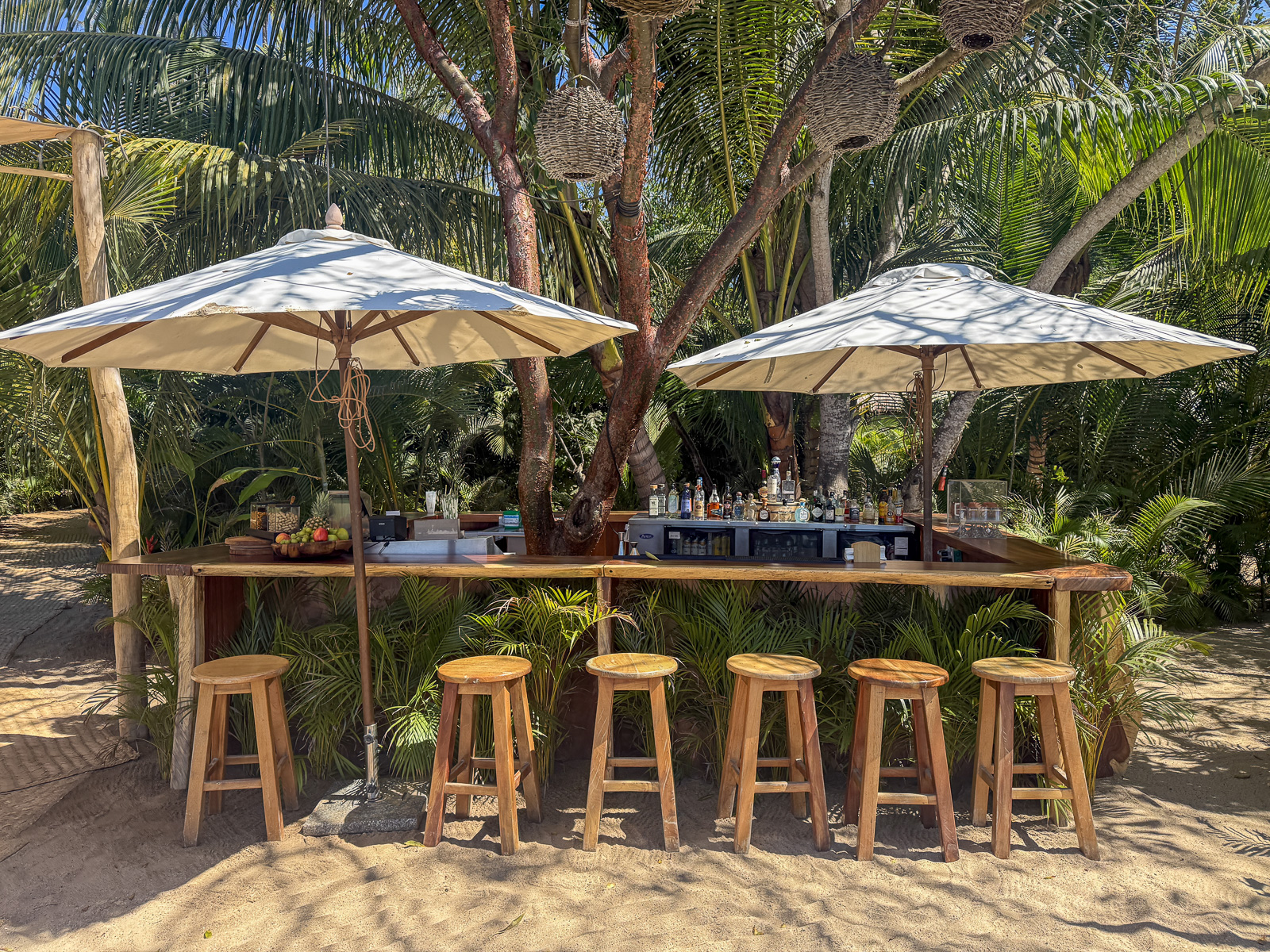
My first morning at Nauka, I was up at sunrise for a workout at the outdoor gym. I’ve worked out in a lot of places over the years, but I’ll remember this one for a long time to come.
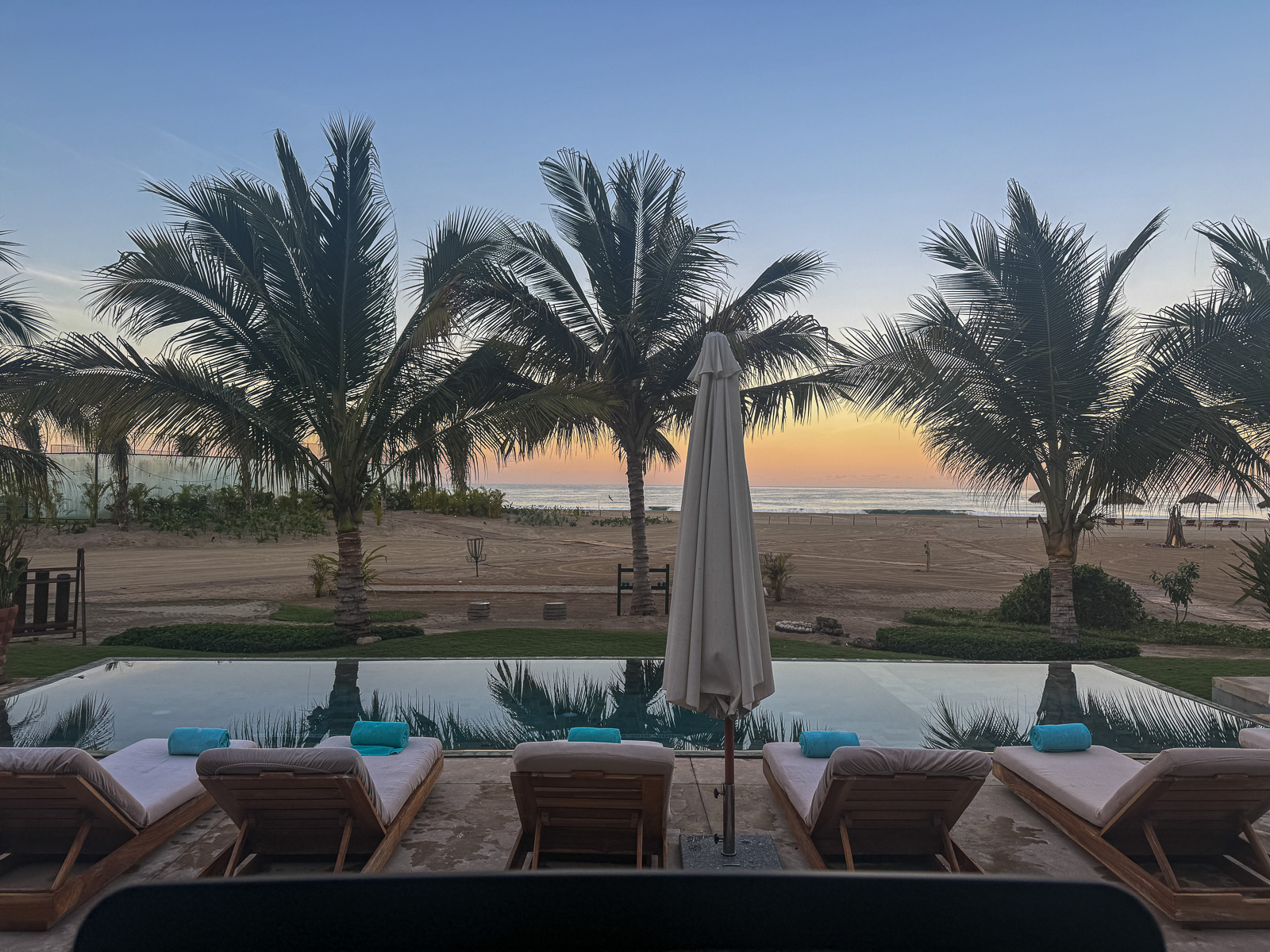
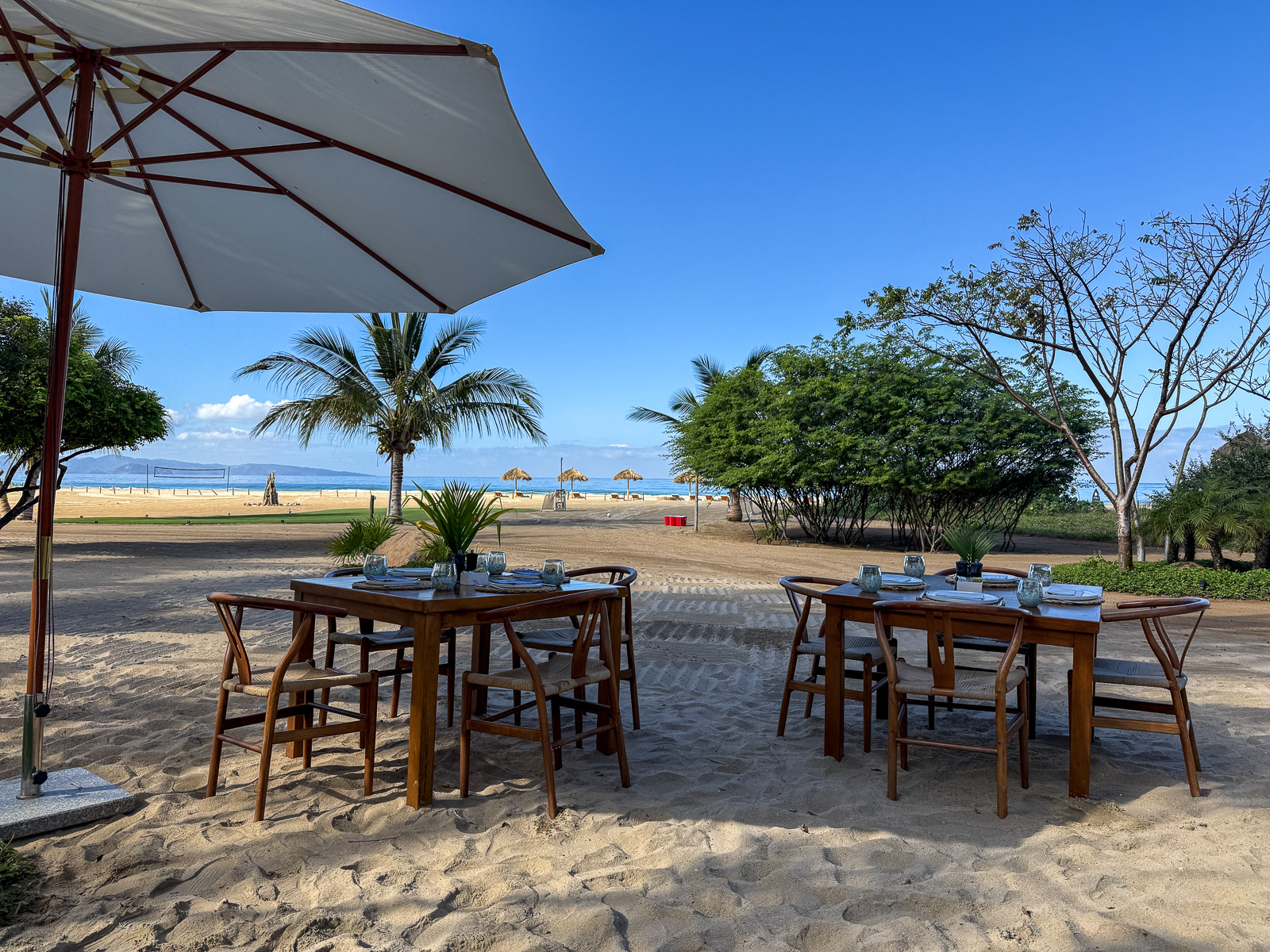
Beyond the courts, there’s a Village restaurant serving breakfast with your feet in the sand, beach chairs and umbrellas lined up along the private shoreline, and enough going on that you could spend multiple full days here without ever feeling like you’d run out of things to do.
The Iguana Boat
On our first day, I noticed a boat tucked behind the Village restaurant. Nice looking boat, nothing unusual. I vaguely thought to myself: “hmm, I wonder how much that gets used, and how it even gets to the water?”
I was not prepared for the answer.
The Iguana boat is, in the simplest terms possible, a boat that walks.
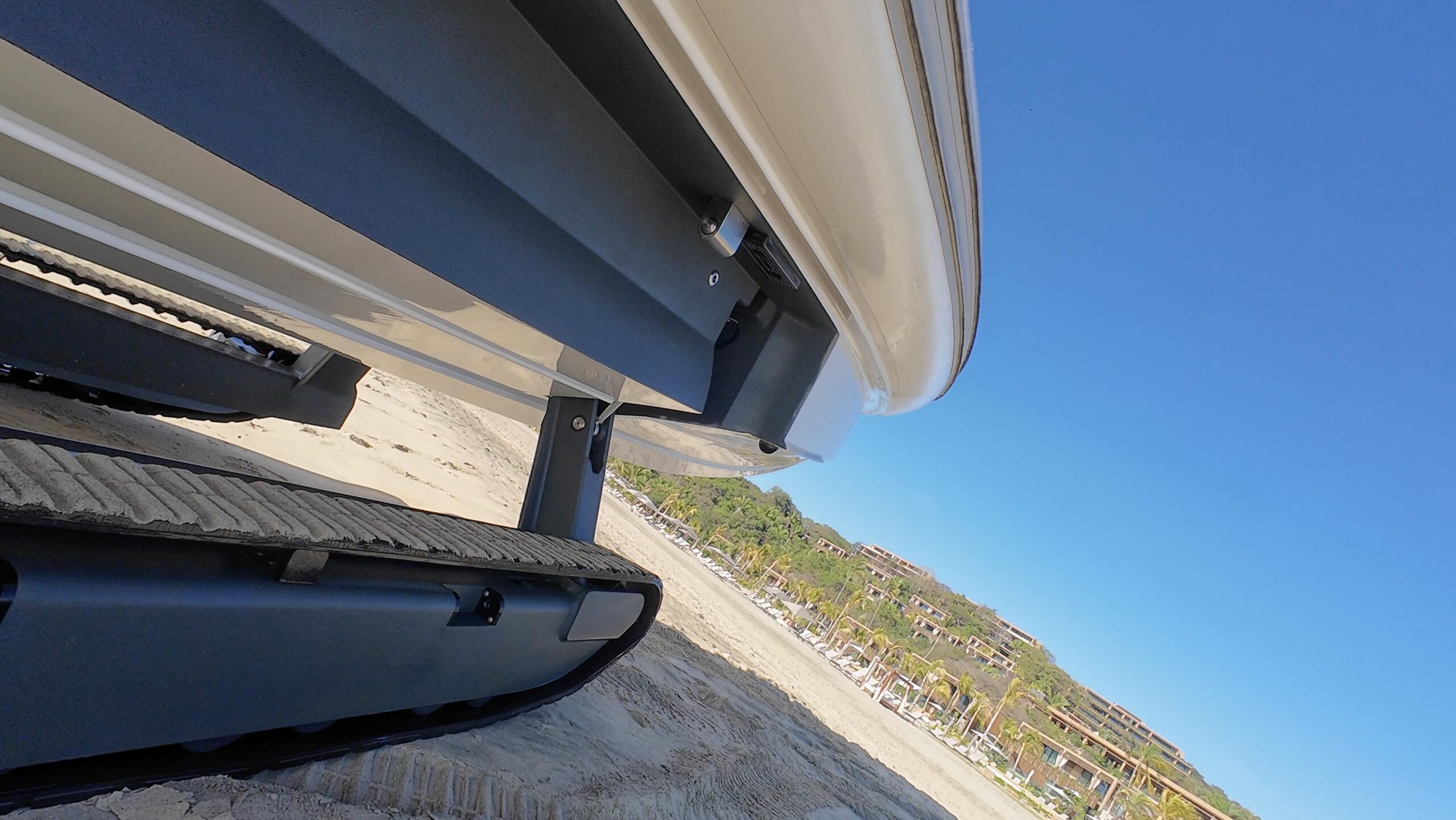
It deploys what feel like tank tracks from its hull, rolls itself across the beach under its own power, and walks directly into the ocean. Standing there watching it happen for the first time, I genuinely didn’t know how to react. It was one of the more absurd and delightful things I’ve ever witnessed, and I had no idea boats like this existed.
Once you’re on the water, the toys at your disposal are exactly what you’d expect from a place like Nauka — tubes, snorkel gear, e-foil, and whatever else you might want.
For our outing, we decided to head out toward the island to see if we could spot the Blue-footed Boobies that inspired the club’s logo. We found them. But the bigger surprise came on the way out — whales. Multiple whales, up close, completely unexpected.
My daughter’s reaction alone made the entire trip worth it.
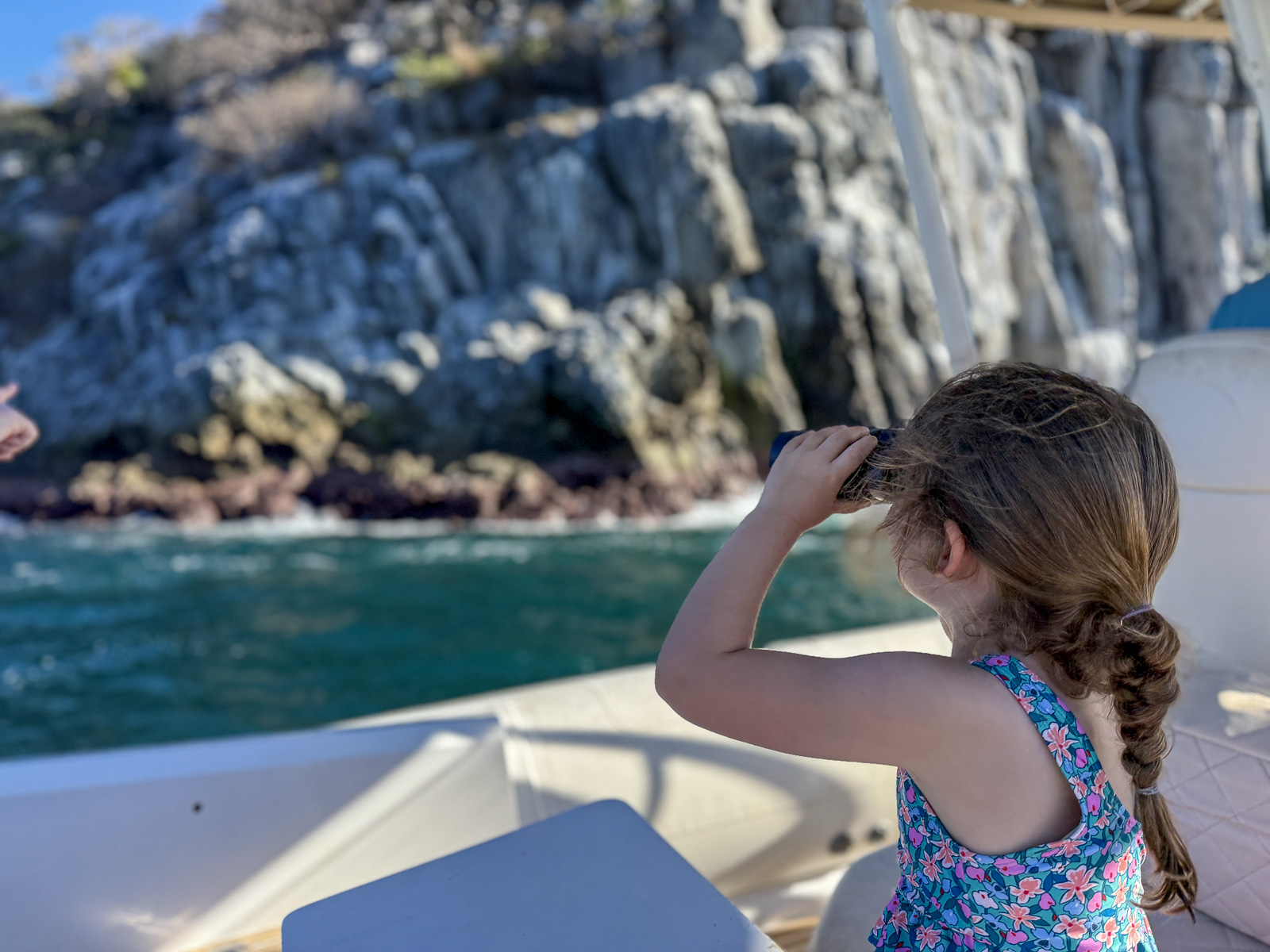
It was one of those moments you don’t plan for and can’t replicate, and somehow Nauka just serves them up like they’re part of the itinerary.
The Beach Club
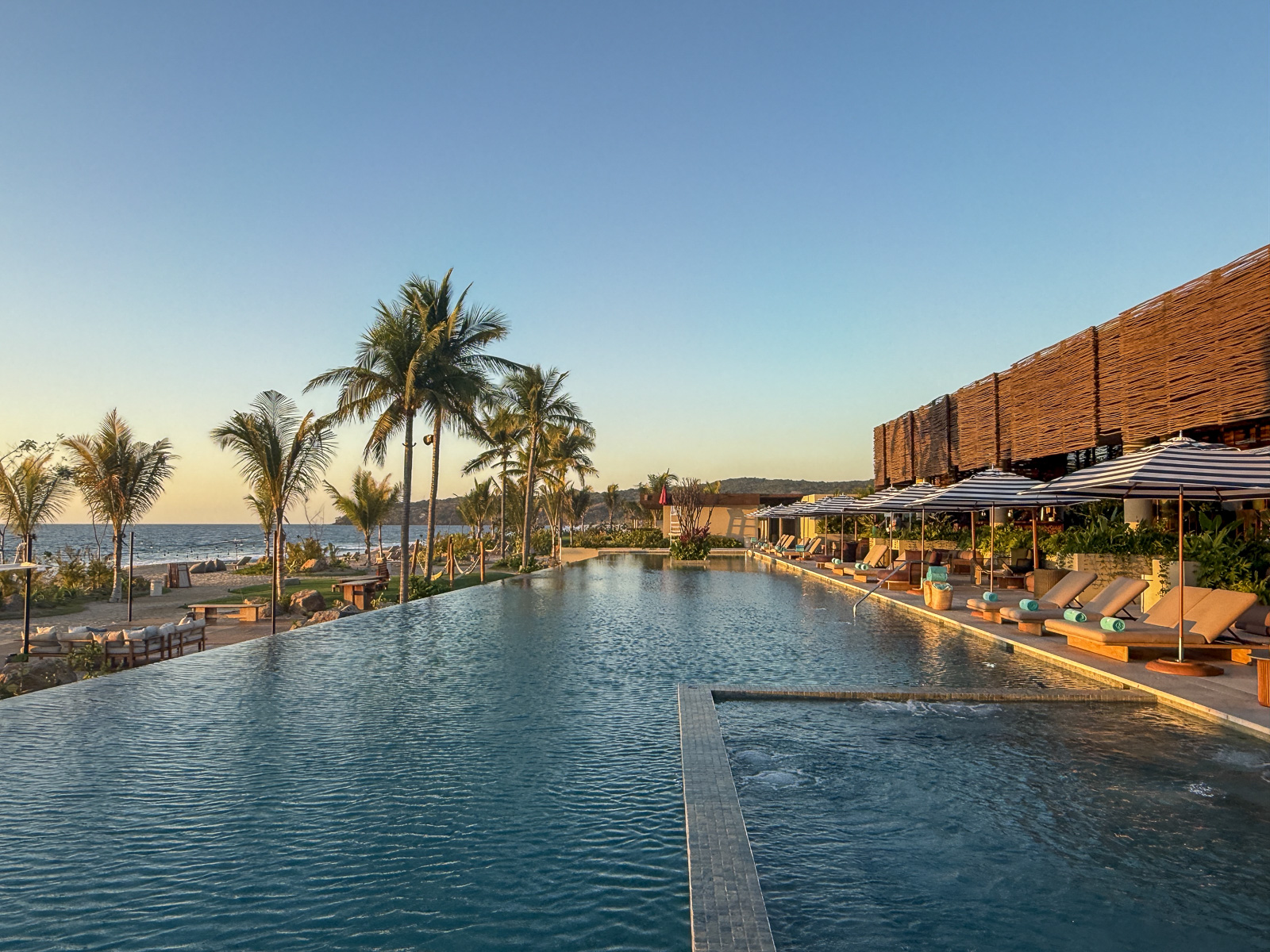
If the Village is Nauka’s casual ocean playground, the Beach Club is where things get elevated.
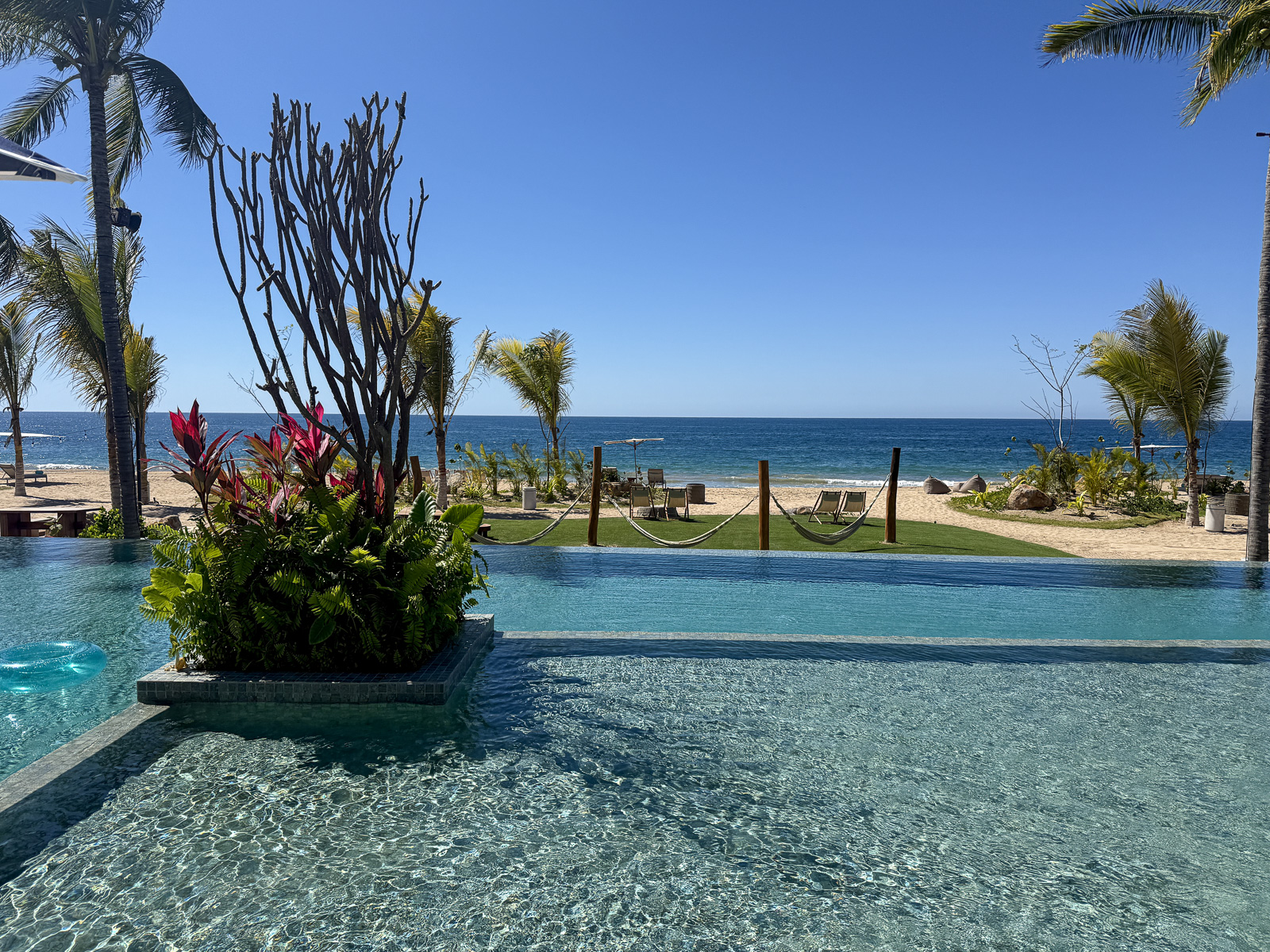
Walking in for the first time, the scale of it hits you immediately. Two bars. Multiple living and dining spaces. A tequila library. And one of the largest pools I’ve ever seen.
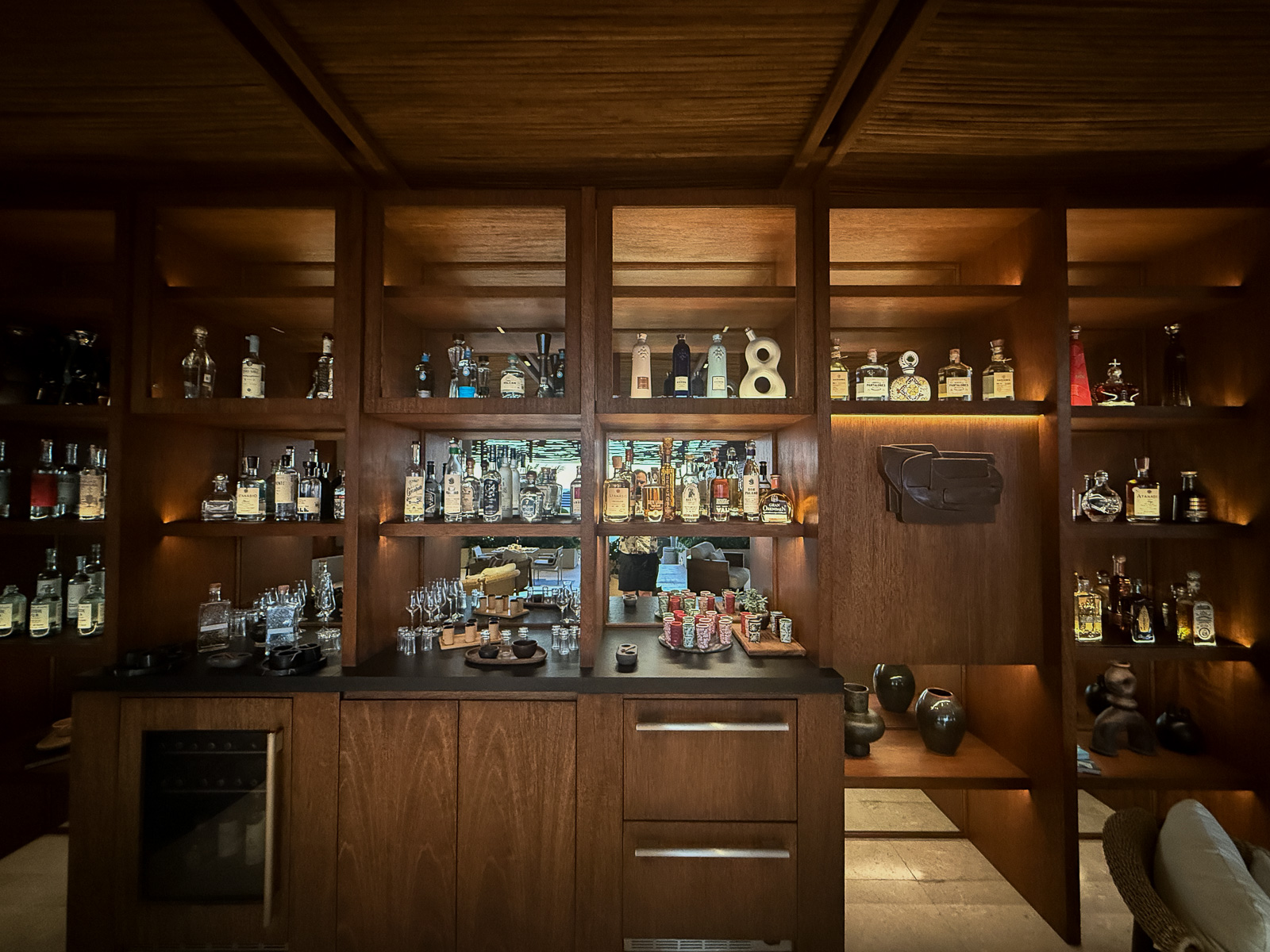
We ate all of our dinners here, and also spent one afternoon enjoying the Club as well. The service was as seamless and anticipatory as everywhere else on the property. Anything you wanted, whenever you wanted it.
Our daughter insisted on visiting the beachfront hammocks every night we were there.
But the real surprise was the food.
I’ll be honest, I didn’t walk into a beach club in Mexico expecting to be wowed at dinner. I was wrong.
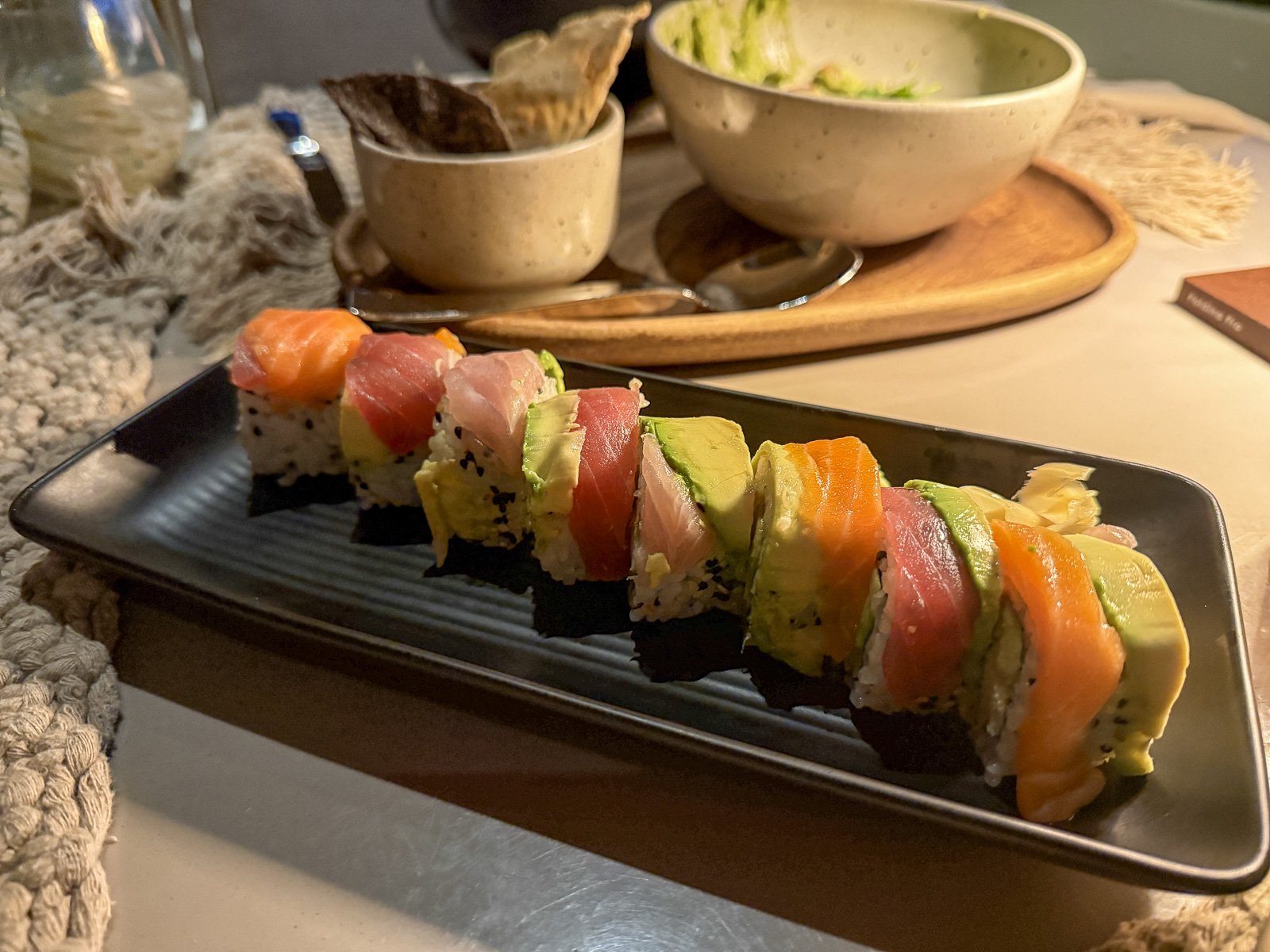
Each evening started with an amuse-bouche, which is not something I anticipated from a beach club setting. The sauces were layered and interesting. The flavors were genuinely elevated across the board. And one night happened to be Taco Night, which I want to be clear was absolutely nothing like your standard country club taco bar.
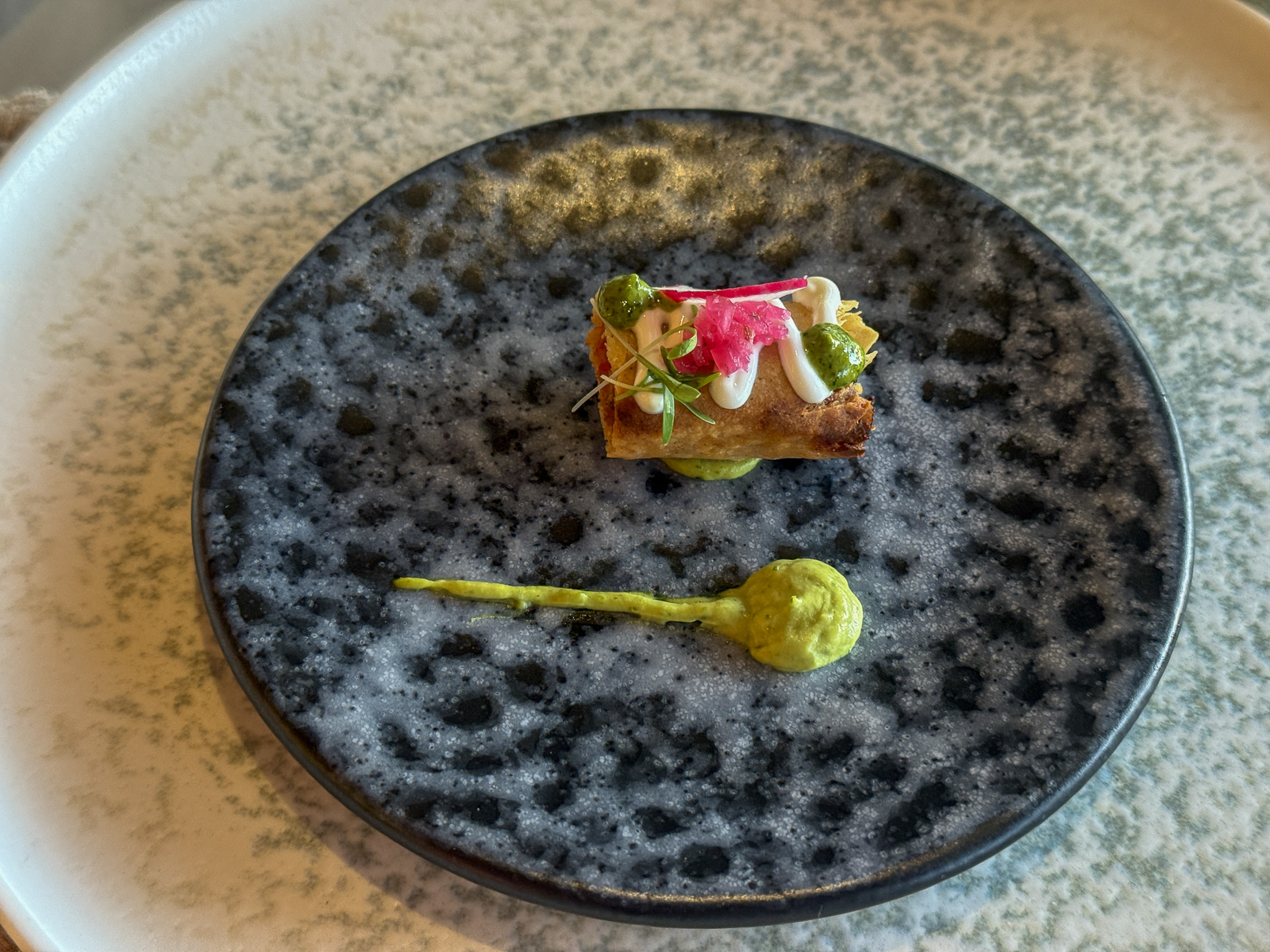
If there’s one thing Nauka does consistently across every corner of the property, it’s this: the food never lets you down. The Beach Club is no exception.
How You Can Play Nauka
By now, you’ve gathered that Nauka is an extraordinarily exclusive place, built for a very limited membership.
But here’s the good news: there is a way in.
Siari is owned by the same group as Nauka, LIFE Properties International by Jaime Fasja, and is situated in the larger Nauka community. As part of this partnership, there is usually a very small number of tee times available for resort guests each month.
Nothing is guaranteed; you have to specifically request access, and availability is limited by design. But if you’re staying at Siari and you make the ask, there’s a real chance you find yourself standing on the first tee of one of the most remarkable golf courses in the world.
At $650 a round, you’ll be paying for the privilege. But I’d put it this way: if you’re the kind of golfer who has ever paid a premium to play somewhere truly special, this is worth every penny and then some. It will be one of the most memorable rounds of your life.
Final Thoughts on Nauka
Less than two years in, what the team at Nauka has already built here is genuinely remarkable. And having seen the plans for what’s still to come, the best version of this place hasn’t even arrived yet.
As more homes are completed and more members spend time on the property, the energy and community will grow. There will be more life in the Village, more familiar faces at La Panga, more kids running between the hammocks at the Beach Club. The feeling of having a world-class private club almost entirely to yourself will gradually give way to something else: a real, living community. And I think that’s going to be a beautiful thing.
The people choosing to build a life here are doing so because they value privacy, family, and above all else, a place to have fun and make memories that last.
After three days at Nauka with my wife and daughter, I can say without hesitation that few places on earth do a better job of delivering exactly that.
You know, assuming you can afford it.
